.png)
Legionella Prevention Beyond Healthcare

Protecting Employees, Clients, and Products in Large Buildings & Manufacturing Facilities
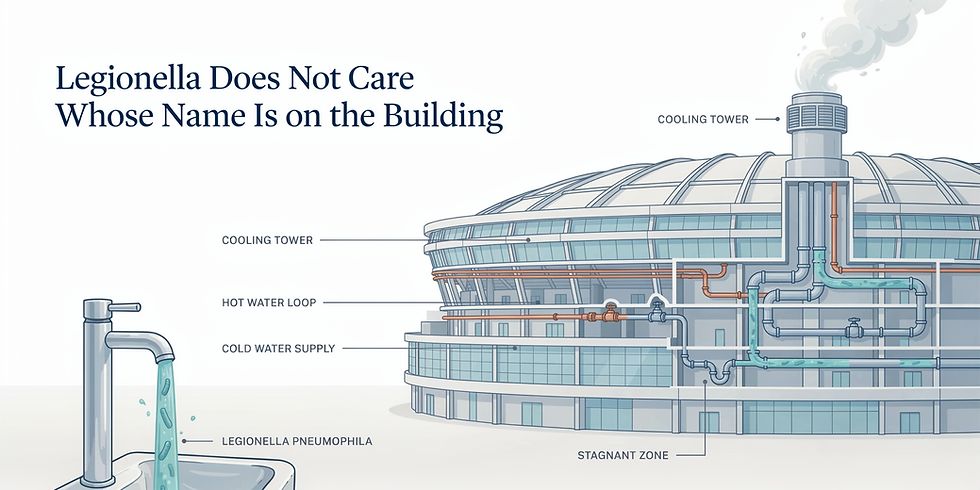
When most people hear Legionella, they immediately think of hospitals or healthcare facilities. But the reality is this: Legionella does not discriminate by industry. Any large building with a complex water system can become a risk environment if water safety is not actively managed.
Manufacturing plants, warehouses, corporate campuses, hotels, schools, government buildings, and industrial facilities all share the same vulnerabilities, large plumbing networks, low-flow areas, storage tanks, cooling systems, and equipment that can allow harmful bacteria to thrive.
At Legionella Specialties, we work with non-medical facilities nationwide to help safeguard employees, visitors, operations, and products through proactive water management and treatment strategies.
Why Legionella Is a Risk in Non-Medical Facilities
Legionella bacteria grow in warm, stagnant water and spread through aerosolized water droplets. In large commercial and industrial buildings, this can include:
Domestic hot and cold water systems
Cooling towers and evaporative condensers
Process water and rinse systems
Emergency eyewash and safety shower stations
Low-use fixtures or seasonal operations
For manufacturers and large employers, the consequences go beyond health concerns. A Legionella incident can lead to:
Employee illness and lost workdays
OSHA and regulatory scrutiny
Production interruptions
Brand and reputational damage
Liability exposure
Preventing these risks is not just a compliance issue it’s a business continuity issue.
How We Help Large Buildings and Manufacturing Plants
Our approach is practical, scalable, and designed to integrate into real-world operations without disrupting production or daily business.
1. Water System Risk Assessments
We start by evaluating how your building actually uses water. This includes identifying stagnation points, temperature inconsistencies, dead legs, and areas where biofilm can form.
2. Ongoing Water Monitoring
Routine testing and monitoring allow facilities to spot trends early instead of reacting to problems after an incident occurs. This proactive approach reduces surprises and improves confidence in water quality.
3. Continuous Water Treatment Solutions
For many non-medical facilities, continuous disinfection is the most effective long-term strategy. These systems help control bacteria throughout the entire water network, not just at the point of use, without relying on constant manual intervention.
4. Operational Support and Documentation
We help facilities establish clear protocols for flushing, monitoring, and response. This documentation supports safety programs, insurance requirements, and internal audits while giving leadership peace of mind.
Protecting More Than People
In manufacturing environments, water safety isn’t only about employee health. Poor water quality can also impact:
Product integrity
Equipment performance and lifespan
Clean-in-place (CIP) processes
Environmental compliance
A well-managed water system supports safer workplaces, consistent production, and higher operational reliability.
A Smarter, Preventive Approach to Water Safety
Waiting for a problem is no longer an acceptable strategy especially in large buildings where risk multiplies quickly. Proactive Legionella prevention protects your people, your operations, and your reputation.
Whether you manage a manufacturing facility, corporate campus, distribution center, or large commercial building, water safety should be part of your overall risk management plan.
If you’re unsure where your facility stands, we’re here to help start that conversation.


Comments