.png)
Legionella Trends to Watch in 2026: Cooling Towers, Winter Operations, and Hidden Water System Risks

As we move into early 2026, one thing is clear: Legionella risk has not gone away, it has simply shifted back into familiar, but often overlooked, areas.
Across healthcare, commercial, and institutional facilities, recent public alerts and risk discussions continue to center on cooling towers, reduced-occupancy operations, and water system oversight gaps.
For facility leaders, infection prevention teams, and risk managers, this is a critical time to reassess water management practices and ensure systems are operating as intended not just documented on paper.
Cooling Towers Are Back in the Spotlight
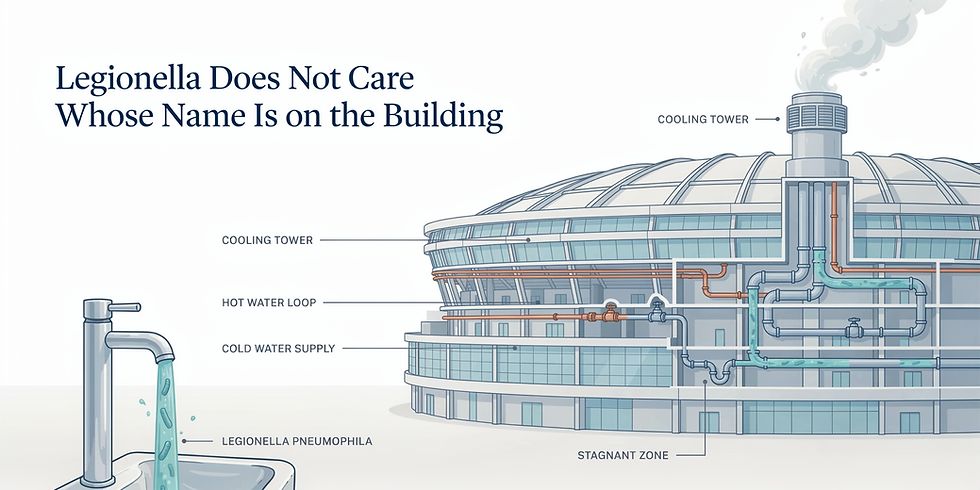
Cooling towers continue to appear in Legionella investigations and public health advisories for a reason. They are uniquely capable of amplifying and dispersing aerosolized water over wide areas when controls fail or drift.
What we are seeing repeatedly is not catastrophic equipment failure it is incremental breakdowns:
Inconsistent chemical control
Missed inspections
Incomplete documentation
Unclear responsibility when readings fall outside limits
Even facilities with long-standing water management programs can be vulnerable if cooling tower oversight becomes routine rather than intentional.
Key takeaway: If your building has a cooling tower, it must be actively managed, monitored, and verified not assumed to be “handled.”
The Risk of “Winter Building Mode”
One of the most underestimated Legionella risk periods is low-use or transitional operations, which often occur during winter months. Common examples include:
Reduced patient census or occupancy
Temporarily closed wings or floors
Seasonal temperature adjustments
Less frequent flushing and system checks
These conditions promote water stagnation, temperature drift, and biofilm development, all of which create ideal environments for Legionella growth.
What makes this dangerous is that these changes are often viewed as temporary or operationally necessary and therefore go undocumented in the water management program.
Key takeaway: Any operational change that affects water use or flow should trigger a documented review of your water management plan.
Guidance Is Clear. Execution Is the Challenge
Industry guidance has matured significantly over the past several years. Resources from the Centers for Disease Control and Prevention, ASHRAE, and The Joint Commission all emphasize the same fundamentals:
Know your water systems
Identify where Legionella risk can increase
Establish measurable control limits
Monitor consistently
Take corrective action when limits are not met
Verify and validate that controls are effective
The challenge we see most often is not a lack of guidance, it is inconsistent execution and documentation across departments, vendors, and facilities.
A Practical Checklist: What Facilities Should Be Doing Right Now
Cooling Towers
Confirm your water management plan explicitly includes cooling towers
Verify inspection, cleaning, and treatment schedules are current
Review who is responsible for escalation when readings fall outside limits
Domestic Hot and Cold Water Systems
Identify low-use or seasonal areas and implement documented flushing protocols
Confirm temperature control strategies are consistent with risk management goals
Validate monitoring locations and frequencies
High-Risk Equipment and Areas
Review devices that generate aerosols or use water (ice machines, therapy equipment, decorative water features)
Confirm maintenance, monitoring, and cleaning procedures are current and recorded
Documentation and Readiness
Update system descriptions when building use changes
Ensure monitoring logs are complete and reviewed
Maintain clear corrective action records
Confirm verification and validation plans are defined and followed
These are the elements surveyors, leadership teams, and risk managers consistently focus on.
How Legionella Specialties Supports Facilities
At Legionella Specialties, we help healthcare and large facilities move beyond “check-the-box” compliance by focusing on practical, defensible water management programs that reflect how buildings actually operate.
Our approach supports:
Clear system mapping and risk identification
Real-world monitoring and control strategies
Actionable documentation that stands up to surveys and audits
Ongoing program support as buildings and operations change
Whether you are reassessing a cooling tower program, updating a water management plan, or responding to operational changes, the goal is the same: reduce risk before it becomes an incident.
Final Thought
Legionella risk rarely appears suddenly. It develops quietly through small gaps, overlooked changes, and assumptions that systems are “fine.” Early 2026 is the right time to look closely, ask hard questions, and ensure your water management program is actively protecting your facility, your staff, and the people you serve.
If you’d like help reviewing your current program or tailoring controls to your building type, Legionella Specialties is here to help.


Comments