.png)
The “Cold Water Problem”: Why Everyone Focuses on Hot Systems and Misses Half the Risk

When it comes to Legionella control, most conversations start and end with hot water systems.
Maintain temperatures above 124°F. Balance return loops. Monitor distal outlets.
All important. All necessary.
But focusing only on hot water systems creates a dangerous blind spot.
Because in many buildings, the problem doesn’t always start in the hot water system. It starts in the cold.
Cold Water Is Not “Safe Water”
There is a long-standing assumption in building water management that cold water is inherently low risk. If it is not being heated into the optimal Legionella growth range, it is often treated as secondary from a control standpoint.
However, both field experience and published research show that this assumption does not hold up under real-world conditions.
A comprehensive review in Frontiers in Environmental Science highlights that water stagnation, reduced disinfectant residual, and biofilm development in premise plumbing can support Legionella colonization regardless of whether the system is classified as hot or cold. Temperature is only one part of the equation.
In other words, cold water systems are not immune. They are simply less monitored.
The Disinfectant Decay Problem
One of the most critical, and often ignored, issues in cold water systems is loss of disinfectant residual over distance and time.
Municipal water may enter a facility with adequate disinfectant levels, but as it travels through:
Storage tanks
Long pipe runs
Low-use branches
Oversized plumbing
…the residual begins to decay.
A review published in Frontiers in Water notes that disinfectant decay is strongly influenced by water age, pipe materials, and biofilm interactions, all of which are common in large building plumbing systems.
By the time water reaches distal outlets, especially in low-use areas, there may be little to no effective disinfectant remaining.
This creates conditions where microorganisms can persist and multiply—even before the water is ever heated.
Water Age: The Silent Driver of Risk
Cold water systems are particularly vulnerable to increased water age, especially in modern buildings designed for efficiency.
Low-flow fixtures, water conservation measures, and intermittent usage patterns all contribute to longer residence times.
Research in premise plumbing systems has consistently shown that reduced water use leads to higher microbial growth and increased Legionella presence at distal outlets. In one well-known study, water use frequency directly impacted Legionella pneumophila levels, with low-use outlets showing higher concentrations.
This is not a theoretical issue. It is happening daily in:
Patient rooms with low occupancy
Seasonal-use areas
Oversized systems built for peak demand that rarely occurs
The result is a system where water sits just long enough for disinfectant to dissipate and biofilm to contribute to microbial regrowth.
Temperature Drift: Cold Water Isn’t Always Cold
Another overlooked factor is temperature creep in cold water systems.
Cold water is often assumed to remain below levels that support Legionella growth. But in reality:
Mechanical rooms
Ceiling spaces
Proximity to hot water lines
Ambient building temperatures
…can all elevate cold water temperatures into ranges that are more favorable for microbial activity.
A review in Frontiers in Environmental Science emphasizes that temperature control in premise plumbing is complex, and deviations from expected temperature ranges can contribute to microbial proliferation.
When combined with low disinfectant residual and increased water age, even moderate temperature increases can shift the balance toward growth.
Cold Water Feeds the Entire System
Perhaps the most important point is this:
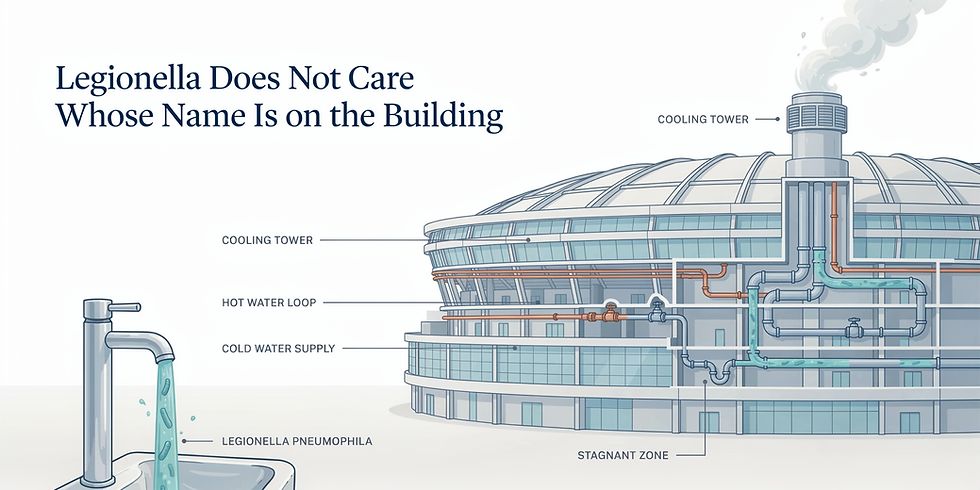
Your cold water system is the source of your hot water system.
If microbial growth begins in the cold water:
It is introduced into heaters
Distributed throughout hot water loops
Delivered to distal outlets
Focusing only on hot water treatment without addressing cold water conditions is like trying to control a problem downstream while ignoring where it starts.
Why This Gets Missed
Cold water risk is often overlooked because:
It is not emphasized as heavily in traditional guidance
It is harder to monitor consistently at distal points
It “looks fine” on basic testing
It is assumed to be protected by incoming municipal disinfectant
But the literature and field data continue to show that system conditions, not assumptions, determine risk.
From Awareness to Control
Addressing the cold water problem requires a shift in approach.
It means:
Looking at entire system hydraulics, not just hot water loops
Understanding where disinfectant residual is being lost
Identifying low-use and high water age areas
Monitoring beyond just a few representative points
And most importantly, it requires consistent control not just periodic intervention.
How Legionella Specialties Approaches the Problem
At Legionella Specialties, we approach water systems as a whole not as isolated components.
Cold water is not an afterthought. It is a critical control point.
Our process includes:
Evaluating system-wide hydraulics and flow patterns
Identifying areas of disinfectant decay and water age
Assessing both hot and cold distribution loops
Using ATP, ORP, and disinfectant monitoring to understand real conditions
From there, we design strategies that address where risk actually exists, not just where it is traditionally expected.
The Role of Continuous Disinfection
In systems where disinfectant residual cannot be maintained consistently, especially across large or complex plumbing networks secondary disinfection becomes an important tool.
Our WaterGuard MO program is designed to help maintain a stable oxidative residual throughout both hot and cold water systems, including distal and low-use areas where conditions often degrade.
When properly applied as part of a broader water management strategy, continuous disinfection can help:
Support residual persistence across the system
Reduce the impact of water age and stagnation
Improve overall system stability
It is not a standalone solution, but it is a critical component in achieving consistent control.
The Bottom Line
Cold water systems are not inherently safe.
They are simply less understood, less monitored, and often underestimated.
And in many cases, they are where Legionella risk begins.
If your water management strategy only focuses on hot water, you are only addressing part of the system.
And when it comes to Legionella, partial control is not control at all.


Comments