.png)
We Designed Buildings to Save Water. Did We Accidentally Create a Water Quality Problem?

For decades, engineers, architects, manufacturers and facility managers have worked to reduce the amount of water buildings use.
Low-flow fixtures. Automatic faucets. High-efficiency toilets. Shorter run times. Reduced water consumption.
From a conservation standpoint, these technologies have accomplished exactly what they were designed to do.
But there is another side to the conversation that deserves more attention.
What happens to water quality when we dramatically reduce how much water actually moves through a building?
The answer is not that water conservation is bad. Far from it.
The issue is that water conservation and water quality cannot be treated as two completely separate engineering goals.
Modern Plumbing Is Operating Differently Than It Used To
The National Institute of Standards and Technology, or NIST, has been studying this issue for years.
NIST notes that many traditional plumbing design approaches were developed using data from decades ago, when buildings routinely experienced much higher flow rates. Today's high-efficiency buildings operate very differently.
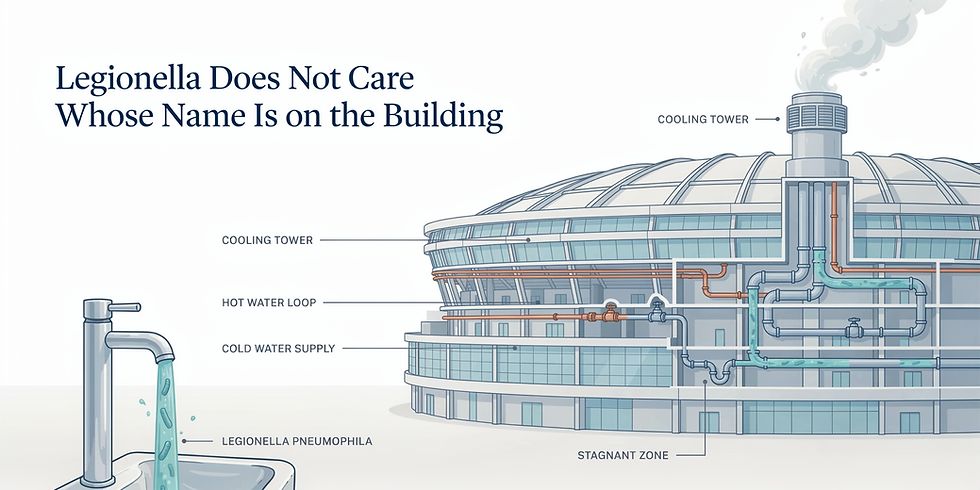
According to NIST, lower flow rates can increase the amount of time water remains inside premise plumbing. That increased residence time, often referred to as water age, can reduce the effectiveness of disinfectant residuals and create conditions more favorable to opportunistic premise plumbing pathogens such as Legionella.
That creates an interesting contradiction.
We want to conserve water.
But we also need enough movement through the plumbing system to maintain water quality.
A Sink Can Be Used All Day and Still Have a Flushing Problem
One of the clearest examples we see in the field is the automatic faucet.
Automatic faucets make perfect sense. They reduce unnecessary water use, eliminate faucets being left running and allow touch-free operation.
But they can also create a false sense that a fixture is receiving plenty of water movement simply because it is used frequently.
Think about what actually happens.
A person places their hands under the faucet.
The faucet activates.
Water runs for several seconds at a relatively low flow rate.
The person removes their hands.
The faucet shuts off.
Repeat that process throughout the day.
The sink may have been "used" dozens or even hundreds of times.
But that does not necessarily mean enough water moved through the branch piping to replace the water that had been sitting there.
That distinction matters.
CDC specifically recommends that facilities recognize the Legionella risks associated with low-flow and mechanically complex fixtures, including electronic sensor faucets. CDC also recommends flushing low-flow piping runs and managing water age as part of Legionella control.
We have encountered this problem firsthand.
Facilities sometimes look at an automatic sink and assume it cannot have a stagnation issue because people are constantly using it.
Then you look at the actual run time and flow rate.
A few seconds of low-flow water is very different from deliberately moving enough water through the piping to exchange the water contained in that branch.
Fixture use and effective flushing are not necessarily the same thing.
The Automatic Faucet Is Not Necessarily the Problem
This is where the conversation gets more interesting.
Automatic faucets can also be part of the solution.
Some modern electronic faucets can be programmed to perform automatic flushing cycles after a specific period of inactivity or on a predetermined schedule.
Instead of relying entirely on handwashing events, the fixture intentionally moves water through the line.
Research supports this concept.
A 2024 study examining water age and Legionella risk modeled both scheduled and "smart" purging systems. Smart purging activated after periods of nonuse rather than simply flushing at fixed intervals. The researchers found that these strategies could reduce water age and modeled Legionella risk while smart purging used less additional water than conventional scheduled purging.
A separate study examining fixture purging similarly found that automated purging can reduce water age and that smart purging can maintain lower water ages while using less water than simple scheduled flushing.
So perhaps the problem isn't the automatic faucet at all.
The problem may be installing a water-saving fixture without considering how the plumbing behind that fixture will be flushed.
Water Age Matters
When water sits in piping, several things can begin to change.
Disinfectant residual can decline.
Water temperatures can move toward the surrounding building temperature.
Biofilm interactions continue.
And conditions can become more favorable for microbial growth.
CDC identifies water age, disinfectant residual and temperature as important control considerations for Legionella in potable water systems.
This is why simply knowing that a fixture is "used regularly" may not tell the whole story.
The better questions are:
How much water is actually moving?
How long does the fixture run?
What is the flow rate?
How much piping is feeding the fixture?
How long has the water in that piping been there?
Is disinfectant residual reaching the fixture?
And if normal use is not exchanging enough water, is there an automatic or manual flushing strategy in place?
Those questions tell us much more about what is happening inside the plumbing system.
The Irony of Water Conservation
There is an interesting irony here.
For years we have focused heavily on preventing buildings from wasting water.
Now we are learning that the challenge may not simply be reducing water use.
It may be determining where water needs to move, how much needs to move and when it needs to move.
That does not mean returning to inefficient fixtures.
It means designing smarter systems.
A programmable electronic faucet capable of recognizing extended inactivity and initiating a deliberate flush may ultimately provide a better balance between conservation and water quality than either extreme.
It conserves water when the fixture is functioning normally.
But it also recognizes when the plumbing needs movement.
That is a very different philosophy from simply setting the lowest possible flow rate and assuming less water is always better.
Water Conservation and Water Safety Should Be Designed Together
The building industry has made tremendous progress in water conservation.
That should continue.
But as buildings become increasingly efficient, we also need to understand how those changes affect the environment inside the plumbing system.
NIST has specifically identified the relationship between water efficiency and chemical and microbial water quality as an area requiring continued research and modernization of premise-plumbing design.
Perhaps the future of water conservation is not simply about using less water.
Perhaps it is about using water more intelligently.
Enough flow where it is needed.
Minimal waste where it is not.
Automated flushing when fixtures sit unused.
Monitoring to confirm that disinfectant residual, temperature and other water-quality parameters remain within established control limits.
And water management programs that recognize that the way buildings use water has changed dramatically.
The question may no longer be: "How little water can this building use?"
A better question might be: "Are we moving the right amount of water through the right places at the right times to protect both conservation goals and water quality?"
Those two goals do not have to compete.
But they do have to be designed together.


Comments