.png)
Legionella Doesn’t Enter Your Building Once. It Enters Every Day.

Most water management strategies are built around a simple assumption:
Legionella is something that shows up, gets detected, and then gets addressed.
The problem is that assumption is wrong.
Legionella is not a one-time event. It is a continuous input.
It Only Takes 72 Hours
Under the right conditions, Legionella can double every 6 to 8 hours.
That means a single viable cell can multiply into a detectable colony in as little as 72 hours.
Let that sink in.
This is not a slow-moving risk. It is a system that can change in a matter of days.
Where Those Cells Come From
If Legionella can grow that quickly, the next question is simple.
Where is it coming from?
1. Incoming Water
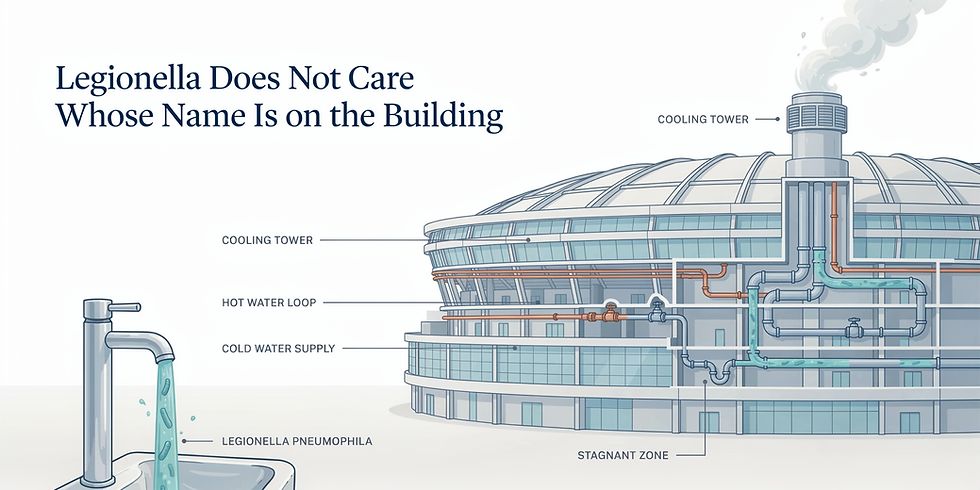
Legionella is commonly present in municipal water systems and can enter your building before you ever take your first sample.
According to the U.S. Environmental Protection Agency, drinking water is not sterile. It can contain low levels of microorganisms, even when it meets all regulatory standards.
The Centers for Disease Control and Prevention also recognizes that Legionella can be introduced into building plumbing systems from the incoming water supply and then colonize under favorable conditions.
This means new bacteria can be introduced into your system every day.
2. Biofilm Inside Your System
Once inside, Legionella does not just survive. It grows.
Biofilm, scale, stagnation, and temperature create the perfect environment for amplification.
Research has consistently shown that Legionella thrives within biofilm and can replicate inside protozoa, gaining protection from disinfectants and environmental stress.
This turns small, continuous inputs into larger system-wide problems.
The Gap Most Facilities Miss
Here is where things break down.
If Legionella can both enter your system continuously and multiply rapidly once it is there, then a one-time fix is not enough.
Flushing, heat treatments, and remediation efforts are designed to address today’s problem.
They do not prevent tomorrow’s problem.
This is why facilities often experience:
Clean test results followed by unexpected positives
Recurring issues in the same locations
Systems that appear stable but are not
The system is not failing overnight.
It is changing between tests.
Testing Only Shows a Snapshot
Most water management programs rely heavily on periodic sampling.
But testing only reflects conditions at a specific place and time.
It does not capture:
Daily fluctuations in incoming water quality
Ongoing bacterial introduction
Rapid microbial growth within biofilm
Guidance from the Centers for Disease Control and Prevention and U.S. Environmental Protection Agency emphasizes maintaining system conditions that limit growth, not just reacting to lab results.
Because the real risk is what happens in between.
Why Systems Drift
Water systems are not static.
They are constantly changing based on:
Temperature variation
Flow patterns and stagnation
Disinfectant residual decay
Biofilm activity
Without continuous control, even small changes can create conditions where Legionella can establish and multiply quickly.
And when growth cycles can occur in hours, small gaps become big problems fast.
The Only Way to Control Both Pathways
If bacteria are entering your system continuously and growing rapidly under the right conditions, then control has to address both pathways.
Ongoing treatment is what makes that possible.
Effective programs focus on:
Maintaining a consistent disinfectant residual throughout the system
Keeping oxidation reduction potential in a range that supports microbial control
Continuously disrupting biofilm and preventing regrowth
This is not about reacting to positives.
It is about preventing the conditions that allow positives to occur.
A Different Way to Think About Water Safety
Legionella is not something that appears out of nowhere.
It is something that is constantly trying to establish itself in your system.
Water systems do not stay the same.
They are either getting better or they are getting worse.
Final Thought
Most facilities are built around detecting problems after they occur.
But when the source is continuous and growth can happen in a matter of days, detection alone is not enough.
Water safety is not about eliminating a single event.
It is about controlling an ongoing process.


Comments