.png)
The Big Difference Between Legionella Treatment Methods: Why Continuous Control Beats Temporary Disinfection

Legionella control is not about finding the strongest chemical or the newest piece of equipment. It is about one question:
Can the treatment method maintain measurable control throughout a complex building water system over time?
That is where many traditional approaches fall short.
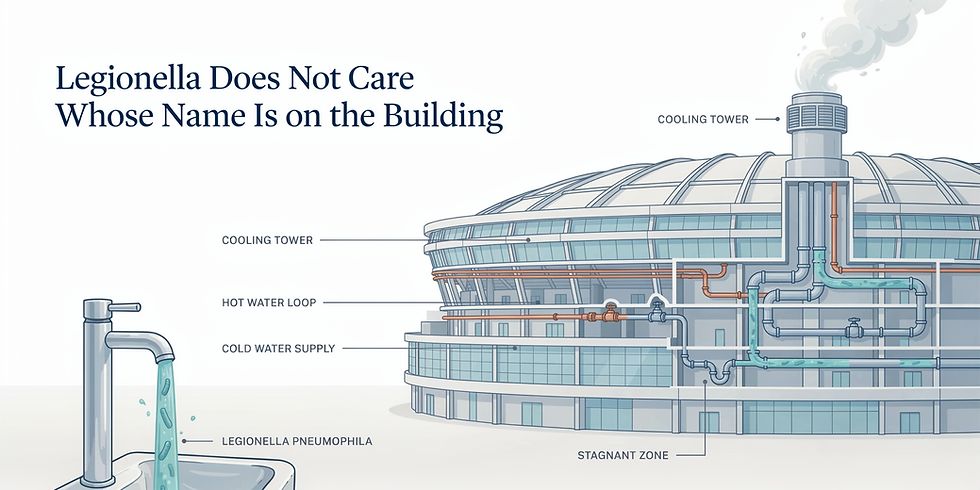
Hospitals, skilled nursing facilities, rehab centers, and other healthcare buildings are not simple plumbing systems. They have long pipe runs, hot and cold loops, storage tanks, mixing valves, low-use fixtures, dead legs, renovations, seasonal use changes, and high-risk patients. In that environment, a treatment method that works in a clean pipe loop, a small section of plumbing, or during a short-term shock event may still fail where it matters most: at the distal outlet, inside biofilm, and over time.
EPA’s scientific literature review on Legionella control makes this point clearly. It says there is no single one-size-fits-all solution, and that long-term eradication of Legionella has not been consistently demonstrated with any treatment technology. The reason is simple: complex buildings have areas where disinfectant, heat, or treatment exposure may not reach well, giving bacteria room to persist in biofilm, stagnant water, and high water-age areas.
That is why the conversation needs to move beyond “What kills Legionella?” and toward what keeps a healthcare water system under control every day.
The Problem With Temporary Wins
A lot of Legionella treatment methods can create short-term improvement. Superheat-and-flush can temporarily reduce bacteria. Hyperchlorination can knock down contamination. Point-of-use filters can protect a single fixture. UV can disinfect water passing through a chamber. Copper-silver ionization can reduce Legionella in some systems when carefully maintained.
But temporary improvement is not the same as long-term control.
Legionella is not only a free-floating organism in water. It can persist in biofilm, survive in low-flow areas, and interact with amoebae and other microorganisms. EPA specifically identifies biofilm, water age, pipe material, temperature, and system-specific conditions as factors that affect treatment success. EPA also notes that Legionella inside amoebae is a major concern because protozoa can help pathogens persist and avoid interventions.
That means a treatment strategy has to do more than disinfect water at one point in time. It has to create a condition inside the plumbing system that makes regrowth difficult.
That is the key difference.
Copper-Silver Ionization: Why It Sounds Better Than It Performs
Copper-silver ionization has been promoted for years as a Legionella control method. The theory is simple: copper and silver ions are released into the water, where they interfere with bacterial cell function. In some published studies, copper-silver ionization has shown effectiveness, especially when properly maintained and paired with good temperature control. A 2007 review concluded that copper-silver ionization can be effective for Legionella control, but also noted that eradication cannot be achieved by any method in isolation and that more controlled long-term studies were needed.
That last part matters.
The strongest argument against copper-silver ionization is not that it has never worked. The argument is that it is often too dependent on ideal operating conditions, and those conditions are difficult to maintain in real healthcare plumbing.
Copper-silver ionization depends on ion levels being delivered, distributed, and maintained throughout the system. That can be affected by pH, water chemistry, pipe material, scale, hot water storage, stagnation, and system complexity. EPA notes that maintaining a residual throughout the plumbing system is critical for copper-silver ionization and other continuous treatments. EPA also notes that treatment effectiveness depends heavily on building-specific characteristics such as pipe material, age, water age, water usage, pH, hardness, organic contaminants, inorganic contaminants, and the types of pathogens present.
In other words, copper-silver ionization is not a “set it and forget it” solution. It is a chemistry-sensitive, system-sensitive technology that has to be monitored closely.
Another issue is distribution. In large buildings, the treatment may not reach all outlets equally. A hospital is full of distal outlets, low-flow areas, rarely used fixtures, mixing valves, and storage points. If the ions do not reach those areas at effective levels, those sections can remain colonized or become recolonized.
There are also water quality concerns. EPA includes copper-silver ionization among the technologies with potential operational and water-quality impacts, and older studies have reported accumulation of copper and silver in hot water tanks at high concentrations.
So the point is not that copper-silver ionization is fake science. The point is that copper-silver ionization does not solve the hardest part of Legionella control: stable, measurable, building-wide control in complicated healthcare plumbing.
That is where many facilities get misled. They buy a technology that can work under controlled conditions, then assume that means their system is controlled. Those are not the same thing.
Heat and Flush: Necessary, But Not Enough
Temperature control is one of the oldest Legionella strategies, and it still matters. The National Academies notes that keeping hot and cold water outside Legionella’s growth range is a fundamental control strategy. Legionella growth is associated with the 25°C to 43°C range, and water heater settings above 60°C can reduce Legionella detection when distal temperatures are also maintained properly.
But heat has two major problems.
First, healthcare facilities cannot always deliver very hot water safely to every distal outlet because of scald risk. Mixing valves, long pipe runs, and fixture-level controls can reduce temperatures before water reaches the point of use.
Second, heat-and-flush is often temporary. It can reduce bacteria, but if the plumbing conditions that allowed Legionella to grow are still present, the system can rebound. EPA lists superheat-and-flush as an emergency remediation strategy, not a complete long-term answer.
Heat is a tool. It is not a complete water management program.
Chlorine: Familiar, But Often Weak Inside Buildings
Chlorine is familiar, inexpensive, and widely used by municipal water systems. But the fact that city water arrives with chlorine does not mean a hospital building is protected.
Inside large plumbing systems, chlorine residual can decay. Hot water, organic material, pipe surfaces, long water age, and stagnation all reduce residual. CDC warns that stagnant water can lead to low or undetectable disinfectant levels and can allow hot water temperatures to drop into the Legionella growth range.
That is why a building can receive properly treated municipal water and still develop Legionella problems inside the premise plumbing.
Chlorine can help, but it often struggles where healthcare systems need the most help: distal outlets, hot water loops, biofilm, and low-use areas.
Chlorine Dioxide: Effective, But Operationally Demanding
Chlorine dioxide has good disinfection properties and has been used successfully in some hospitals. EPA reviewed studies where chlorine dioxide reduced Legionella occurrence, sometimes significantly. But the same EPA review also shows why chlorine dioxide can be difficult to rely on.
In one hospital study, Legionella-positive sites decreased from 66.7% to 32.9% over nine years, and mean counts dropped 78%, but that required a long-term water safety plan, multiple disinfectants, filtration, and eventually a switch to monochloramine after chlorine-tolerant Legionella species were identified.
In another study, chlorine dioxide reduced Legionella occurrence from 96% of sampling sites to 46% across three hospital hot water systems, but it did not eliminate the problem. In another case, treatment was ineffective when boiler water temperature was below 58°C.
EPA also identifies chlorite and chlorate as prominent byproducts of chlorine dioxide disinfection, and notes taste and odor concerns at concentrations used for secondary disinfection.
So chlorine dioxide can be useful. But it is not simple. It can require tight residual control, careful monitoring, management of byproducts, and the right temperature conditions.
Monochloramine: Better Persistence, But Not Always Practical
Monochloramine often persists longer than free chlorine and has evidence supporting better control of Legionella in some building plumbing systems. A CDC-associated study found that monochloramine in drinking water provided better control of Legionella growth in building plumbing than chlorine.
That is important.
But monochloramine is not automatically available or practical for every facility. It can interact with existing municipal water chemistry, require specific feed and monitoring systems, and create other water-quality considerations. Like every residual-based disinfectant, it still has to reach the right locations at the right concentration, and the building still needs active water management.
Monochloramine may be stronger than chlorine in some applications, but it is not a magic fix for complex plumbing.
UV and Ozone: Strong at the Treatment Point, Weak Afterward
UV and ozone are powerful disinfectants at the point of treatment. The problem is that neither produces a lasting disinfectant residual in the plumbing system. EPA specifically states that ozone and UV do not produce a residual, meaning treated water may be susceptible to later contamination unless treatment is at the point of use or paired with supplemental treatment.
That is a major limitation for Legionella.
Legionella risk is not only at the mechanical room. It is in the distribution system: the lines, fixtures, tanks, showers, hoses, sinks, low-use outlets, and biofilm. A treatment method that disinfects water only as it passes one point does not keep the rest of the building protected.
UV and ozone can be part of a strategy, but by themselves they do not create system-wide residual control.
Point-of-Use Filters: Protection, Not Treatment
Point-of-use filters are valuable in high-risk areas. They can provide immediate protection at a sink or shower and are useful during outbreaks, construction, or remediation.
But filters do not treat the plumbing system.
They are a barrier, not a correction. They do not reduce biofilm in the piping. They do not improve water age. They do not stabilize disinfectant residual. They do not address colonization upstream of the filter.
For high-risk patient areas, filters can be the right temporary or supplemental tool. But if a facility is using filters as the main Legionella strategy, it may be protecting the patient while ignoring the building.
Why Mineral Oxychloride Is Different
Mineral oxychloride changes the conversation because it is not built around a one-time shock, a single fixture barrier, or a narrow mechanical-room treatment point. It is designed as a continuous disinfection method that supports measurable control throughout the building water system.
The published Legionella Specialties study evaluated mineral oxychloride treatment across more than 105 healthcare and long-term care facilities in the United States. Baseline testing included conductivity, pH, ORP, free and total chlorine, ATP, and temperature. Among 1,213 initial baseline sample points, approximately 40% had ATP readings greater than 5 RLU, with some readings above 1,578 RLU. After mineral oxychloride treatment and standard flushing protocols over six months, fewer than 1% of post-treatment samples exceeded 5 RLU.
That is the kind of data healthcare facilities should care about because it is not just a lab claim. It is field data from real buildings, real plumbing, and real operating conditions.
The key advantage is not simply that mineral oxychloride can reduce microbial activity. The advantage is that it creates a measurable oxidative environment that can be tracked through ORP, ATP, disinfectant residual, temperature, and other field indicators. The published study states that mineral oxychloride treatment stabilized key water quality parameters and supported ongoing monitoring as part of proactive Legionella risk management.
That matters because Legionella control should never depend on hope.
It should depend on measurable conditions.
The Real Argument: Biofilm and Stability
The strongest case for mineral oxychloride is not that it is simply “stronger.” Stronger is not always better in potable water. The strongest case is that it is better aligned with the way Legionella actually survives in buildings.
Legionella control requires:
A residual or treatment effect that reaches the system.
Conditions that suppress microbial regrowth.
Biofilm management, not just bulk-water disinfection.
Field measurements that show whether the system is moving toward control.
Ongoing monitoring, because a negative Legionella sample is only a snapshot.
EPA’s review emphasizes that maintaining residual throughout a premise plumbing system is critical for technologies that rely on residual control. It also points out that more than one treatment or control measure may be needed because complex buildings have areas where heat or disinfectant exposure is limited.
Mineral oxychloride fits that reality better than traditional “shock and hope” methods. It is not just a response after a positive result. It is a continuous control strategy that can be paired with flushing, monitoring, sampling, and corrective action.
That is why the difference matters.
Copper-silver ionization asks the facility to believe that metal ion delivery will remain effective throughout a complex system. Chlorine asks the facility to believe the residual will survive hot water loops and long water age. UV asks the facility to believe point-of-treatment disinfection is enough. Filters ask the facility to protect the outlet without treating the system. Heat asks the facility to maintain temperatures that may not be practical at every distal point.
Mineral oxychloride asks a better question:
Can we create and verify a stable water environment that suppresses microbial activity over time?
That is the standard healthcare should be using.
A Fair Comparison of Common Legionella Control Methods
Method | Where it helps | Where it falls short |
Superheat-and-flush | Emergency response, temporary reduction | Does not provide lasting residual; regrowth can occur if underlying conditions remain |
Hyperchlorination | Shock response after contamination | Can be corrosive, temporary, and difficult to sustain throughout a building |
Free chlorine | Familiar and widely used | Residual can decay in hot water, stagnant areas, and complex plumbing |
Chlorine dioxide | Can reduce Legionella and biofilm | Requires tight residual control; byproducts include chlorite/chlorate; hot water residual can be difficult |
Monochloramine | More persistent than chlorine in some systems | Not practical for every facility; requires careful chemistry and monitoring |
Copper-silver ionization | Can reduce Legionella when maintained correctly | Sensitive to water chemistry, pH, distribution, scaling, and monitoring; not reliable as a standalone answer |
UV | Strong at point of treatment | No residual; does not control downstream biofilm or distal plumbing |
Ozone | Strong oxidizer at treatment point | No residual; limited downstream protection |
Point-of-use filters | Immediate protection at specific outlets | Does not treat the plumbing system or biofilm upstream |
Mineral oxychloride | Continuous control, measurable oxidative environment, biofilm suppression, field-verifiable performance | Must still be paired with monitoring, flushing, WMP discipline, and corrective action |
The Bottom Line
Legionella is not defeated by a single treatment event. It is controlled by maintaining a building water system in a condition where Legionella has a harder time surviving, multiplying, and reaching patients.
That is why treatment methods should be judged by real-world performance, not marketing claims.
A good Legionella control method should be continuous. It should be measurable. It should address biofilm. It should support field verification. It should work with a water management program, not replace one.
Copper-silver ionization has a long history and some evidence of effectiveness, but it is too dependent on water chemistry, ion distribution, system design, and ongoing maintenance to be treated as the best answer for modern healthcare water systems.
Traditional shock treatments can reduce risk temporarily, but they do not create stable control.
UV, ozone, and filters can protect specific points, but they do not solve building-wide colonization.
Mineral oxychloride is different because it focuses on the real target: continuous, measurable control inside the plumbing system.
For healthcare facilities, that is the difference between reacting to Legionella and managing it.
And when vulnerable patients are involved, reacting is not enough.


Comments