.png)
What Happens Between Quarterly Water Tests?

Most healthcare facilities understand the importance of routine water testing. Quarterly sampling has become a standard part of many water management programs, helping organizations monitor for Legionella and evaluate the overall health of their water systems.
But there is an important question that often goes unasked:
What happens during the other 89 days between testing events?
The reality is that water systems do not remain static between quarterly tests. They are constantly changing. Temperatures fluctuate. Water usage patterns shift. Disinfectant levels rise and fall. Biofilm grows, sheds, and regrows. Equipment ages. Construction activities occur. Occupancy changes.
A quarterly water sample provides a snapshot in time. It does not tell the complete story of what happened before the sample was collected or what may happen after.
Understanding what occurs between testing events is often the difference between simply monitoring a water system and truly managing it.
Water Systems Change Every Day
Unlike many building systems, water systems are dynamic.
Every faucet use, every shower, every patient discharge, every plumbing repair, and every change in water demand affects conditions within the piping network.
Consider just a few factors that can change between quarterly testing events:
Hot water temperatures
Cold water temperatures
Disinfectant residuals
Water age
Occupancy levels
Construction activities
Equipment performance
Flushing frequency
Seasonal source water changes
Even a facility that performs exceptionally well during one round of testing may experience significant changes before the next sampling event occurs.
The absence of a positive test result does not necessarily mean conditions remained stable throughout the quarter.
Biofilm Does Not Wait for Testing Day
One of the biggest misconceptions in water management is that bacterial growth only becomes important when a sample is collected.
In reality, biofilm is continuously developing within plumbing systems.
According to the Centers for Disease Control and Prevention, biofilms can form on virtually any surface that comes into contact with water. Once established, biofilm creates a protective environment that allows microorganisms to survive and multiply while becoming more resistant to disinfectants.
Biofilm growth does not follow a quarterly schedule.
It develops every day.
This means that conditions supporting bacterial growth can begin developing weeks or even months before they are detected through routine sampling.
Disinfectant Residuals Can Change Quickly
Many facilities rely on municipal disinfectants or secondary disinfection systems to help control microbial growth.
However, disinfectant levels are rarely constant.
Residuals may fluctuate due to:
Changes in incoming water quality
Seasonal source water variations
Increased water demand
Equipment maintenance
Feed system performance issues
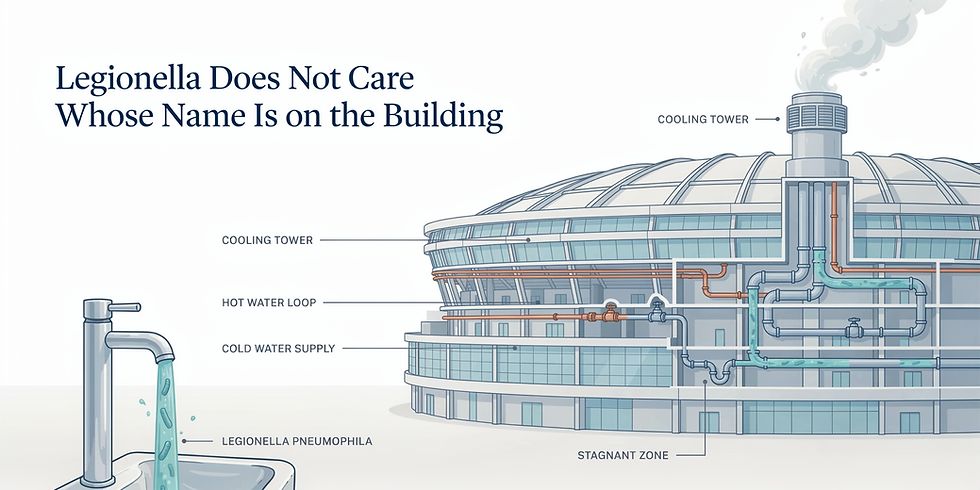
Stagnation in low-use areas
A system that maintains excellent residuals today may not maintain the same levels next month.
Without routine monitoring, these changes can go unnoticed until the next testing event.
Occupancy Patterns Matter More Than Many Realize
Healthcare facilities are constantly evolving.
Patient rooms may sit vacant.
Entire wings may experience reduced occupancy.
Departments may relocate.
Construction projects may temporarily alter water usage patterns.
Every one of these changes affects water movement throughout the building.
When water remains stagnant for extended periods, disinfectant residuals decrease, temperatures become more favorable for bacterial growth, and biofilm development accelerates.
Many recurring water quality issues can be traced back to changing usage patterns that occurred long before a sample was ever collected.
Equipment Does Not Always Fail Dramatically
When people think about water system failures, they often imagine catastrophic events.
The reality is usually much less obvious.
A recirculation pump may begin performing slightly below specification.
A temperature sensor may drift out of calibration.
A chemical feed pump may slowly lose output.
A mixing valve may begin operating inconsistently.
These small changes often develop gradually over weeks or months.
By the time quarterly testing identifies a problem, the underlying issue may have existed for a considerable period.
Why Trending Data Matters
A single test result is valuable.
A trend is powerful.
When facilities track information such as:
Temperature
Disinfectant residuals
ORP
ATP readings
Flushing activities
Positive sample history
They gain insight into how the system behaves between testing events.
Trends help identify developing problems before they become outbreaks, positive samples, or regulatory concerns.
Instead of reacting to water quality issues, facilities can begin preventing them.
Testing Is Essential, But It Is Not the Entire Program
Quarterly testing remains one of the most important tools available for verifying water system performance.
However, testing alone is not a water management program.
Testing confirms what conditions looked like on the day the sample was collected.
Effective water management focuses on controlling conditions every day between those sampling events.
The most successful programs combine routine testing with ongoing monitoring, trend analysis, preventive maintenance, flushing programs, and operational oversight.
Final Thoughts
Quarterly testing provides critical information, but water systems do not pause between sampling events.
Biofilm continues to grow.
Disinfectant residuals continue to fluctuate.
Occupancy patterns continue to change.
Equipment continues to age.
The facilities that consistently achieve strong water quality results understand a simple reality:
Water systems change every day, not every quarter.
The goal is not simply to pass the next round of testing.
The goal is to maintain control of the system during all the days in between.


Comments