.png)
When Prevention Fails, Headlines Follow: Why Every Facility Needs a Water Management Plan

This week alone, two separate chemical tank failures made headlines. One occurred in Garden Grove and another in Washington. Different facilities. Different systems. Different circumstances.
But they all point to the same reality:
Accidents and incidents happen.
Equipment fails. Tanks rupture. Pumps stop working. Sensors malfunction. Human error occurs. Aging infrastructure deteriorates. Even well-managed facilities can experience unexpected problems. The question is not whether a facility could have an issue. The question is whether the facility is prepared when it happens.
That is why prevention and preparedness are absolutely critical in facility water systems.
Unfortunately, many organizations still treat water management as something optional, something to address only after a positive Legionella sample, patient illness, or regulatory issue arises. By then, the consequences can already be severe, expensive, and potentially deadly.
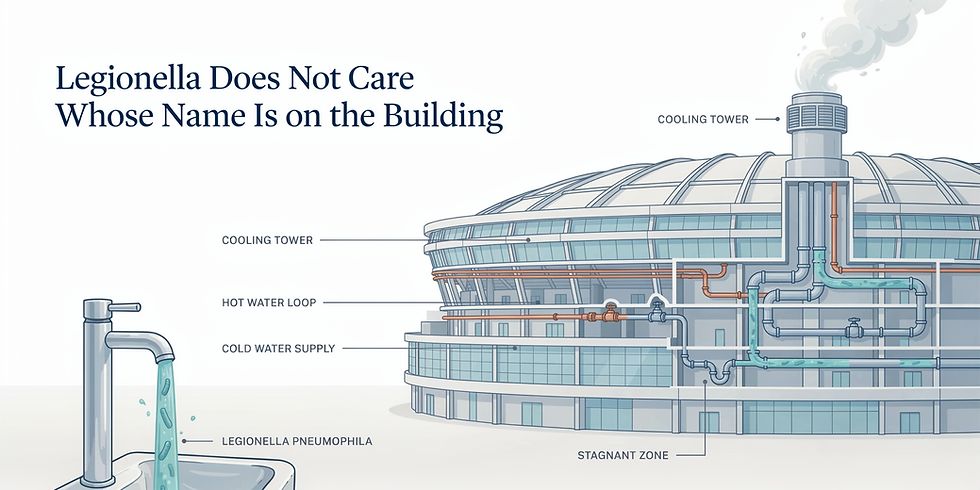
Legionella bacteria are especially dangerous because they are often invisible until people begin getting sick. They thrive inside complex plumbing systems, biofilm, stagnant water, dead legs, underused piping, decorative water features, storage tanks, and improperly maintained hot water systems. Once established, they can spread quietly throughout an entire building through aerosolized water droplets from showers, sinks, cooling systems, and medical equipment.
According to the Centers for Disease Control and Prevention, nearly 9 out of 10 Legionnaires’ disease outbreaks investigated were linked to problems that could have been prevented with more effective water management programs.
That statistic alone should be a wake-up call for every healthcare facility, senior living center, hotel, and large commercial building.
Even more concerning is the severity of Legionnaires’ disease itself.
The CDC reports that approximately 1 out of every 10 people who contract Legionnaires’ disease will die from complications. In healthcare-associated cases, the mortality rate rises dramatically to approximately 25%.
For immunocompromised patients, elderly populations, and individuals with chronic respiratory conditions, the risks become even greater. Studies have shown mortality rates can become extremely high in vulnerable patient populations if infections are not identified and treated quickly.
This is one reason healthcare-associated Legionnaires’ disease receives so much attention from regulators, infection prevention teams, and accrediting organizations. A single waterborne outbreak can place patients, residents, visitors, and staff at serious risk.
And beyond the human toll, the financial consequences can be devastating.
Legionella-related lawsuits and settlements have reached into the millions of dollars. Publicly reported settlements tied to outbreaks at hotels, healthcare facilities, and resorts have included cases ranging from several hundred thousand dollars to over $6 million.
In one widely publicized example tied to the Flint water crisis, lawsuits connected to Legionnaires’ disease exposure exceeded $100 million in claims after multiple deaths were associated with the outbreak.
But the financial impact is only part of the damage.
The reputational harm to a facility can last for years.
No hospital, senior care facility, or hotel wants their name attached to a Legionella outbreak in a news headline. Patients lose trust. Families ask difficult questions. Regulators become involved. Legal exposure increases. Internal investigations begin. Staff morale suffers. Public confidence can disappear almost overnight.
And in many cases, the warning signs were there long before the outbreak occurred.
That is why proactive water management matters.
A proper water management program is not simply a binder sitting on a shelf for compliance purposes. It is an active, living strategy designed to identify and reduce risk before problems escalate. Effective programs typically include:
Facility-wide system mapping
Identification of high-risk areas and vulnerable populations
Routine monitoring of disinfectant residuals, ORP, temperatures, and microbial indicators
Flushing procedures
Corrective action protocols
Ongoing testing and documentation
Secondary disinfection where appropriate
Emergency response procedures
Quarterly reviews and continuous improvement
Preparation also means understanding a very important reality:
Municipal water entering a building does not guarantee the internal plumbing system is safe.
Once water enters a facility, it encounters storage tanks, miles of piping, varying temperatures, stagnation points, scale buildup, and biofilm. In large buildings, these conditions can create ideal environments for bacteria growth if systems are not actively managed.
The facilities that stay ahead of problems are the ones that recognize water safety is not reactive. It is preventative.
They understand that prevention costs far less than remediation, lawsuits, reputational damage, patient harm, or becoming tomorrow’s headline.
At Legionella Specialties, we believe the goal is not simply responding to waterborne problems after they occur. The goal is building systems and strategies that help prevent those problems from occurring in the first place.
Because when incidents happen, preparedness is what separates a manageable situation from a crisis.


Comments