.png)
Water Safety Is Bigger Than Legionella: Understanding Today's Water Quality Challenges
Updated: Jul 21

When most people think about water safety in healthcare facilities, long-term care communities, commercial buildings, and industrial water systems, one name typically comes to mind: Legionella. Given the severe health risks associated with Legionnaires' disease, that focus is well deserved. According to the Centers for Disease Control and Prevention (CDC), Legionella is the leading cause of reported waterborne disease outbreaks associated with building water systems in the United States.
However, today's water quality professionals are facing a much broader landscape than they were just a decade ago.
Facility managers, infection prevention teams, engineers, and environmental health professionals are now responsible for understanding an increasingly complex mix of biological, chemical, and operational water quality concerns. While each presents unique challenges, they all reinforce the same fundamental truth: protecting water systems requires a proactive, comprehensive approach rather than reacting to individual problems as they arise.
Water Contamination Isn't One-Size-Fits-All
When discussing water contamination, it's important to recognize that not every contaminant behaves the same way.
Some contaminants are living microorganisms capable of growing and multiplying within plumbing systems under the right conditions. Others are naturally occurring metals or minerals that become problematic at elevated concentrations. Still others are synthetic chemical compounds introduced into the environment through manufacturing, industrial activities, firefighting foams, consumer products, or other human activities.
Examples of contaminants that water professionals may encounter include:
Legionella bacteria
Pseudomonas aeruginosa
Nontuberculous Mycobacteria (NTM)
Lead
Copper
Nitrates
Disinfection byproducts
Emerging contaminants such as PFAS (per- and polyfluoroalkyl substances)
Each of these contaminants presents different risks, behaves differently within water systems, and requires different monitoring or treatment strategies. There is no universal solution that addresses every water quality concern.
Why Biological Contaminants Require Continuous Management
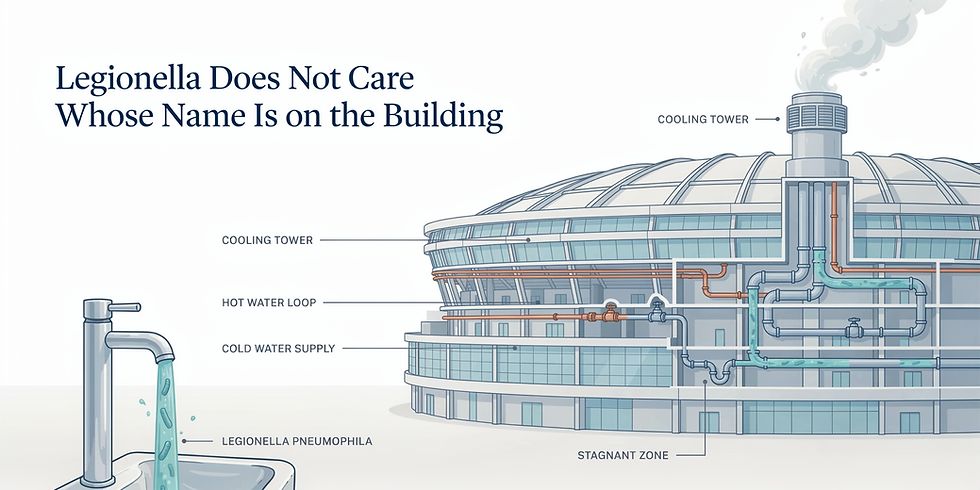
Legionella remains one of the most significant biological risks within large building water systems because it can colonize plumbing infrastructure and spread through aerosolized water from showers, cooling towers, decorative fountains, and other devices.
This is why organizations such as the CDC, ASHRAE, and The Joint Commission emphasize comprehensive water management programs. These programs focus on identifying risk areas, maintaining proper disinfectant residuals and temperatures, monitoring system performance, and responding quickly when conditions change.
At Legionella Specialties, this philosophy guides everything we do. Effective water management isn't simply about treating a problem after it appears—it's about creating conditions that make it difficult for harmful bacteria to establish themselves in the first place.
Chemical Contaminants Present a Different Challenge
While biological contaminants can often be controlled through proper system management and continuous treatment, chemical contaminants require an entirely different approach.
Unlike bacteria, many chemical contaminants cannot be eliminated through traditional disinfection methods. Instead, they often require specialized filtration, adsorption, membrane technologies, or other advanced treatment processes designed specifically for the contaminant being addressed.
As water science continues to evolve, facility owners are becoming increasingly aware that maintaining safe water involves understanding both biological and chemical risks.
Why PFAS Is Receiving National Attention
Among emerging contaminants, few have received as much recent attention as PFAS, or per- and polyfluoroalkyl substances.
Often referred to as "forever chemicals," PFAS are a large group of synthetic chemicals that have been used for decades in products such as non-stick cookware, stain-resistant fabrics, food packaging, and certain firefighting foams. Their chemical structure makes them extremely resistant to breaking down in the environment, allowing them to persist in soil and water for many years.
The U.S. Environmental Protection Agency (EPA) has significantly expanded efforts to regulate PFAS in drinking water, while many state agencies have implemented additional monitoring requirements and cleanup initiatives. As research continues, regulations and treatment technologies are expected to evolve alongside our understanding of these compounds.
Although PFAS differs dramatically from Legionella in both its source and treatment, it represents another example of how water quality management continues to become more comprehensive.
Looking at the Entire Water System
One of the biggest shifts occurring throughout the water industry is moving away from focusing on individual contaminants and toward evaluating the health of the entire water system.
Water quality is influenced by numerous factors, including:
Water age and stagnation
Plumbing system design
Temperature control
Disinfectant residuals
Corrosion
Biofilm development
Source water quality
Operational practices
Emerging environmental contaminants
Each of these factors can influence the overall safety and performance of a building's water system. Understanding how they work together allows facilities to make informed decisions that improve both safety and long-term reliability.
Preparing for the Future of Water Management
Regulations, technologies, and scientific understanding will continue to evolve. What remains constant is the importance of having a thoughtful, science-based approach to managing water systems.
Organizations that invest in proactive monitoring, comprehensive assessments, and evidence-based treatment strategies are better positioned to reduce risk, protect occupants, and adapt to changing regulatory expectations.
At Legionella Specialties, we remain committed to helping our clients navigate this evolving landscape through proven water management practices, advanced testing, practical guidance, and solutions grounded in current science. As new challenges emerge, our focus remains the same: helping facilities build safer, healthier water systems through knowledge, prevention, and continuous improvement.


Comments