.png)
Is Flushing a Treatment, or Are We Just Resetting the Clock?
Flushing is one of the most common responses when a building has a water-quality concern.
A low-use room?
Flush it.
A stagnant branch line?
Flush it.
A positive Legionella result?
Increase flushing.
There is good reason for that.
Flushing replaces older water with fresher water, can restore disinfectant residual, improve temperature conditions and reduce accumulated organisms in the water column.
But a recent study raises an important question:
What happens after the flushing stops?
The Immediate Results Can Look Very Good
A 2026 study published in Environmental Science & Technology used a pilot-scale building water system to compare high-flow flushing with conventional shower use and evaluate their effects on total bacteria, Legionella species and other microorganisms in premise plumbing.
High-flow flushing was approximately 16 liters per minute for five minutes. Conventional showering was approximately 7 liters per minute for eight minutes.
Both methods initially reduced bacterial concentrations by removing accumulated planktonic, or free-floating, biomass.
In other words:
Flushing worked.
But that was not the end of the story.
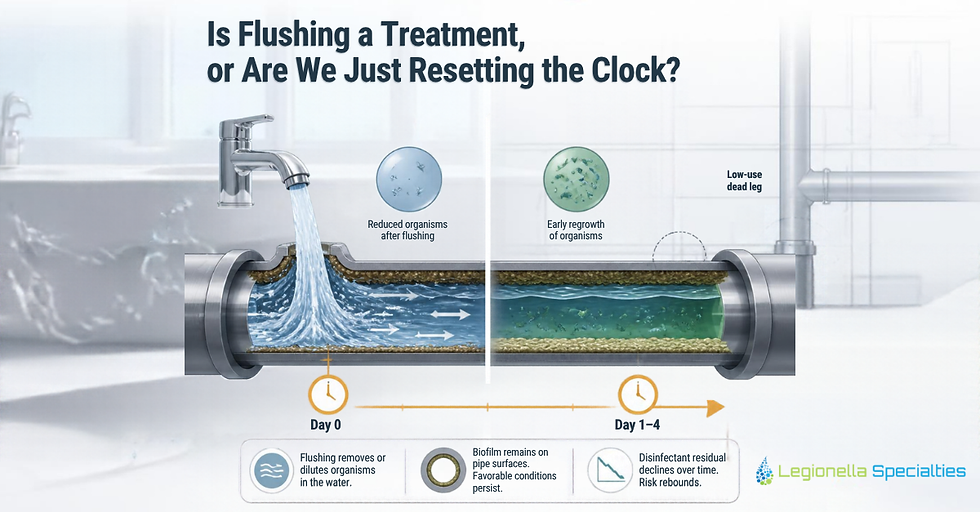
The researchers found that total bacterial concentrations rebounded within one to four days after either flushing or showering.
In the absence of chloramine, Legionella concentrations increased again during the three to ten days following water use.
That finding should get the attention of anyone responsible for a building water management program.
Flushing Removes Water. It Does Not Necessarily Remove the Environment That Created the Problem.
This is the distinction that matters.
When we flush a fixture, we exchange the water sitting in the pipe.
But what happens to everything behind that water?
The biofilm may still be there.
The sediment may still be there.
The dead leg may still be there.
The temperature problem may still be there.
The disinfectant residual may disappear again.
And the fixture may go right back to sitting unused.
If those underlying conditions have not changed, flushing may improve the water temporarily without changing the environment that allowed the problem to develop in the first place.
That leads to a very different way of looking at flushing:
Flushing may reset the water. It does not necessarily reset the plumbing system.
And What Happens When the Fixture We Are Flushing Is a Shower?
There is another part of this conversation that deserves attention.
A shower does not simply move water.
It creates aerosols.
That matters because Legionnaires' disease occurs primarily when a person inhales aerosolized droplets containing Legionella into the lungs. Showers are one of the recognized exposure pathways because they are specifically designed to turn water into droplets that can become airborne.
EPA notes that microorganisms in premise plumbing can result in human exposure through inhalation, including suspended and aerosolized water droplets.
That creates an important water-management question.
Imagine a shower that has been sitting stagnant and contains elevated Legionella.
We turn it on because we want to flush that stagnant water out of the line.
From a water-age standpoint, that makes sense.
But during those first moments, we may also be taking the very water we are concerned about and producing an aerosol from it.
That does not mean showers should never be flushed.
It means the procedure matters.
Who is nearby?
Who performs the flushing?
Is the room occupied?
Are we dealing with a high-risk patient population?
Do we already know that Legionella is present?
Are we simply opening a shower and walking away, or is there an actual flushing procedure designed around exposure as well as water movement?
When the purpose of an intervention is to reduce risk, we also need to think about the exposure we may create while performing that intervention.
Biofilm Changes the Conversation
One reason Legionella can be so difficult to control is that the organism does not simply float freely through the water waiting to be flushed down the drain.
Building plumbing contains biofilm.
Biofilm develops on wetted surfaces inside pipes, valves, fixtures and equipment. It can provide nutrients and protection for microbial communities and makes controlling organisms inside a complex plumbing system much more difficult.
This is another reason a seemingly successful flush can be misleading.
The 2026 study found that high-flow flushing was more effective than conventional showering at removing Legionella from biofilms.
But the microbial population still demonstrated recovery after water use.
So you may remove organisms from the bulk water and disturb portions of the biofilm without fundamentally changing the conditions supporting microbial growth.
If those conditions return, the organisms can return with them.
Chloramine Made an Interesting Difference
One of the most interesting findings in the 2026 study involved chloramine.
Without chloramine, Legionella concentrations increased over the three to ten days following flushing or showering.
When approximately 1 mg/L chloramine was present during the experiment, Legionella was suppressed for more than ten days, even though the measurable chloramine itself decayed within hours after water use.
That is significant.
It tells us that disinfection combined with water movement can produce a very different result than water movement alone.
Chloramine has legitimate advantages. It is relatively persistent in distribution systems, and CDC notes that utilities sometimes choose chloramine specifically because it can maintain a disinfectant residual longer than free chlorine.
But chloramine is not without operational considerations.
EPA's review of Legionella-control technologies identifies potential issues associated with monochloramine, including nitrification, corrosion, disinfection by-products and effects on certain plumbing materials. Once nitrification occurs, maintaining a chloramine residual can also become more difficult.
So the takeaway from this study should not simply be:
“Use chloramine.”
The much bigger lesson is:
Flushing alone and continuous microbial control are two different things.
This Is Why We Believe Continuous Treatment Matters
At Legionella Specialties, this is one of the reasons our approach focuses on the entire water system rather than repeatedly responding to individual fixtures.
If the problem is microbial growth within a complex plumbing environment, our goal should be more than periodically pushing that water out of the end of a pipe.
We want to change the conditions throughout the system that allow the problem to persist.
That is where WaterGuard MO, our Mineral Oxychloride continuous-treatment technology, fits into our approach.
Rather than relying solely on intermittent shock treatments or repeated flushing events, Mineral Oxychloride is applied continuously to maintain an oxidizing disinfectant residual throughout the water system while addressing microbial activity and biofilm over time.
And we have now published data examining that approach.
Our 2025 study evaluated Mineral Oxychloride treatment across more than 105 hospitals and long-term-care facilities.
After six months of treatment, 90% of ATP measurements were 0 or 1 RLU, fewer than 1% exceeded 5 RLU, and the average post-treatment ORP was approximately 705 mV. The study also documented the need for higher initial treatment levels in many systems followed by lower stabilized dosing as microbial activity and biofilm were brought under control.
Those results are why we view WaterGuard MO very differently from a temporary corrective action.
We are not trying to win the five minutes after a flush.
We are trying to control the environment during the days, weeks and months that follow.
WaterGuard MO is designed to provide continuous microbial control, maintain an oxidizing residual and progressively address the biofilm environment where Legionella can persist.
That is an important difference.
The Goal Should Not Be Another Temporary Knockdown
Look at what the 2026 flushing research demonstrated.
Flush the system and bacterial concentrations drop.
Then they begin to return.
Add a sustained disinfectant and Legionella suppression lasts longer.
That should change the conversation.
Instead of asking only:
“How long should we flush?”
we should also be asking:
“What are we doing between flushes to prevent the system from returning to the same conditions?”
That may include:
Maintaining proper hot- and cold-water temperatures
Managing water age
Eliminating unnecessary dead legs
Maintaining adequate circulation
Monitoring disinfectant residual
Controlling biofilm
Using automated flushing where appropriate
Implementing continuous secondary disinfection when the system requires it
Verifying performance through ongoing monitoring and testing
No single corrective action replaces a complete water management program.
That includes WaterGuard MO.
Continuous treatment works best as part of a system-wide approach that combines treatment, monitoring, testing, flushing where appropriate and correction of the physical conditions contributing to microbial growth.
So Should We Stop Flushing?
Absolutely not.
That is not what this research says, and it is not what we are suggesting.
Flushing remains an important tool for managing water age and moving stagnant water out of low-use plumbing.
But the research gives us a reason to stop thinking of flushing as though the story ends when clear, fresh water reaches the drain.
Because the real question is what happens tomorrow.
And three days later.
And ten days later.
If the plumbing returns to the same temperature, the same stagnation, the same declining disinfectant residual and the same biofilm environment, we should not be surprised when the microbial population returns too.
Sometimes flushing is exactly the right corrective action.
Sometimes automated flushing is needed.
Sometimes plumbing modifications are required.
Sometimes temperature or circulation needs to be corrected.
And sometimes the water system needs continuous treatment.
The answer depends on the building.
But the objective should always be the same:
Do not simply remove the evidence of the problem. Change the conditions that created it.
Flushing can be an important part of the strategy.
It should not become the entire strategy.
Because if the underlying conditions never change, we may not actually be fixing the problem.
We may just be resetting the clock.


Comments