.png)
Why Are We Still Having Legionella Outbreaks in Cities With Legionella Regulations?

New York City has some of the most detailed cooling tower requirements in the country.
Cooling towers must be registered. They require a Maintenance Program and Plan. Water treatment is required. Operating parameters must be monitored. Legionella testing is required. Records must be maintained. Corrective actions are prescribed when results exceed established thresholds.
And in May 2026, New York City made those requirements even more aggressive, increasing Legionella culture testing for operating cooling towers from every 90 days to at least every 31 days.
Yet on September 10, 2026, the New York City Health Department announced an investigation into a new community cluster of Legionnaires' disease in the South Bronx. At that time, five people had been diagnosed and one person had died.
Three days later, the Health Department reported that preliminary PCR testing had detected Legionella DNA in 10 cooling towers in the affected area and ordered all 10 towers cleaned and disinfected while additional testing continued. The City was careful to note that a positive PCR result did not establish any individual cooling tower as the source of the illnesses.
That raises an important question.
If a city has extensive Legionella regulations, required testing, required water management procedures, and enforcement, why can Legionella problems still occur?
The answer may be one of the most important lessons in water management:
Compliance creates the framework for control. It does not, by itself, create control.
A Water Management Program Is a Management Tool
A good Water Management Program is essential.
The CDC describes water management as a continuous process that includes identifying areas where Legionella could grow and spread, establishing control measures and control limits, monitoring those measures, taking corrective action when limits are not met, verifying that the program is being implemented as designed, and validating that it is actually effective.
Every one of those steps matters.
But there is an important distinction between having a program and controlling the water.
A written plan does not change water temperature.
A logbook does not increase disinfectant residual.
A completed checklist does not remove biofilm.
A testing schedule does not correct stagnation.
And a Water Management Program sitting on a shelf does not control Legionella.
The program provides the roadmap. The physical conditions inside the water system determine whether bacteria can grow.
The Water Does Not Know Whether You Are Compliant
This is where water management becomes much more than paperwork.
Legionella responds to environmental conditions, not documentation.
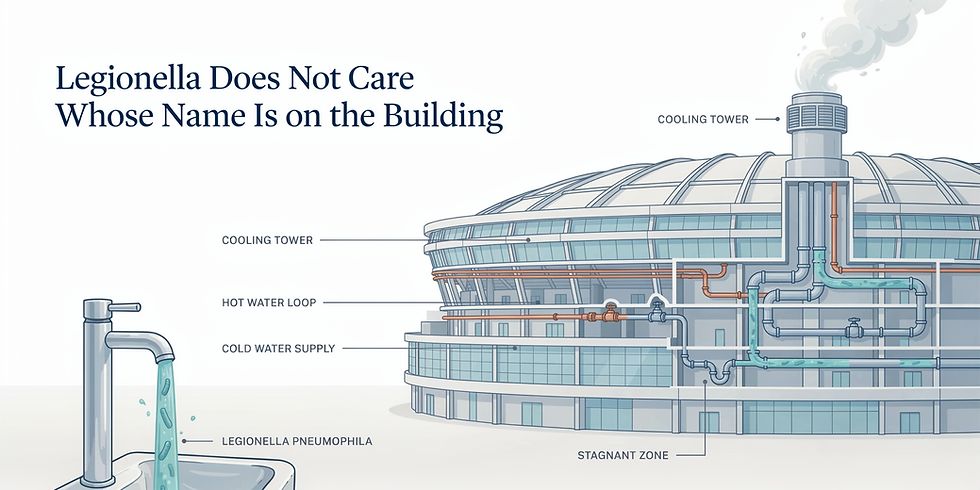
CDC identifies several conditions that can contribute to Legionella growth in building water systems, including inadequate disinfectant levels, water stagnation, favorable temperatures, and the presence of biofilm, scale, and sediment.
Those conditions can change.
A building can be performing well one month and experience a very different situation the next.
Water usage changes.
Temperatures change.
Municipal water conditions can change.
Disinfectant residual can decline as water moves farther into a building.
Equipment can malfunction.
Sections of piping can experience reduced flow.
Biofilm can develop.
Maintenance or construction can alter how water moves through the system.
The existence of a Water Management Program does not prevent those changes.
The purpose of the program is to detect them and respond to them before they become a larger problem.
Testing Is Important, but Testing Is Not Treatment
There is another distinction that is sometimes lost in water management.
Testing tells us something about the condition of the system. Testing does not change the condition of the system.
Legionella testing is an extremely important tool for validating whether a water management strategy is working.
But taking a sample does not reduce bacterial growth.
The same is true for measurements such as temperature, disinfectant residual, pH, conductivity, ORP, or other water-quality indicators.
Measurement creates information.
Control requires action.
If a facility identifies declining disinfectant, increasing water age, inadequate temperatures, or other unfavorable conditions, the value of monitoring comes from what happens next.
That may mean flushing, adjusting temperatures, changing operational procedures, cleaning equipment, modifying treatment, correcting a mechanical problem, investigating an unexpected change, or taking other actions identified within the facility's Water Management Program.
CDC specifically describes Water Management Programs as requiring predetermined responses when control measures fall outside established limits.
In other words:
The alarm is not the solution. It tells you when the solution is needed.
New York Is Actually a Good Example of This Principle
The recent New York situation should not be interpreted as proof that regulation is ineffective.
In fact, it demonstrates why an active system of monitoring, testing, response, and enforcement exists in the first place.
When the South Bronx cluster was identified, the Health Department began testing cooling towers in the affected area. Preliminary PCR testing detected Legionella DNA in 10 towers, and the City ordered those systems remediated while culture testing continued.
New York had also strengthened its cooling tower requirements earlier in 2026, including monthly Legionella sampling and summertime hyperhalogenation requirements.
Following another Legionnaires' disease cluster earlier in the summer, the City announced additional initiatives on September 1 intended to strengthen enforcement, identify potentially unregistered cooling towers, improve public transparency, explore faster testing methods, and evaluate emerging technologies.
That is what continuous water management looks like on a much larger scale.
Identify.
Monitor.
Measure.
Respond.
Evaluate.
Improve.
Then repeat.
The Same Principle Applies Inside a Building
For facility leadership, the lesson is much broader than cooling towers or New York City.
A facility can have an excellent Water Management Program and still need to continually ask:
Is our water actually under control?
Those are two different questions.
One is answered by reviewing documentation.
The other is answered by examining what is happening throughout the water system.
Are temperatures where they are supposed to be?
Is disinfectant reaching distal locations?
Are conditions stable or trending in the wrong direction?
Are low-use areas being identified?
Are corrective actions actually fixing the problem?
Are testing results validating the strategy?
Has anything changed within the building or incoming water supply that could affect the program?
And most importantly:
When the data tells us something has changed, are we doing something about it?
Compliance Should Be the Beginning, Not the Finish Line
Water Management Programs, regulations, testing requirements, and documentation are all critical components of Legionella prevention.
They create accountability.
They establish expectations.
They provide a systematic way to identify risk and respond when conditions change.
But the objective was never simply to produce documentation.
The objective is safer water.
That distinction matters.
A facility should absolutely be able to demonstrate that it has a Water Management Program.
But the more important question may be whether that program is producing measurable control of the conditions that allow Legionella to grow and spread.
Because ultimately, Legionella does not know whether the paperwork is complete.
It only knows whether the conditions allow it to grow.
And that is why effective water management must go beyond having a plan.
The plan has to be alive in the building.


Comments