.png)
When Legionella Makes the News, Every Facility Should Pay Attention
Legionella is back in the headlines.
In September, the New York City Health Department reported that preliminary testing detected Legionella in ten cooling towers during its investigation of a cluster of Legionnaires' disease cases in the South Bronx. One of those cooling towers was located at Yankee Stadium.
That last sentence is understandably the one that generated headlines.
But it is important to be precise about what actually happened.
The testing was performed using PCR, which detects genetic material from Legionella bacteria but cannot determine from that result alone whether the organisms detected were alive or dead. New York City health officials have also stated that a positive cooling tower result does not establish that the tower was the source of exposure. At the time of this writing, the illnesses being investigated have not been linked to Yankee Stadium.
That distinction matters.
This should not be a story about Yankee Stadium.
It should be a reminder for every organization responsible for a building water system.
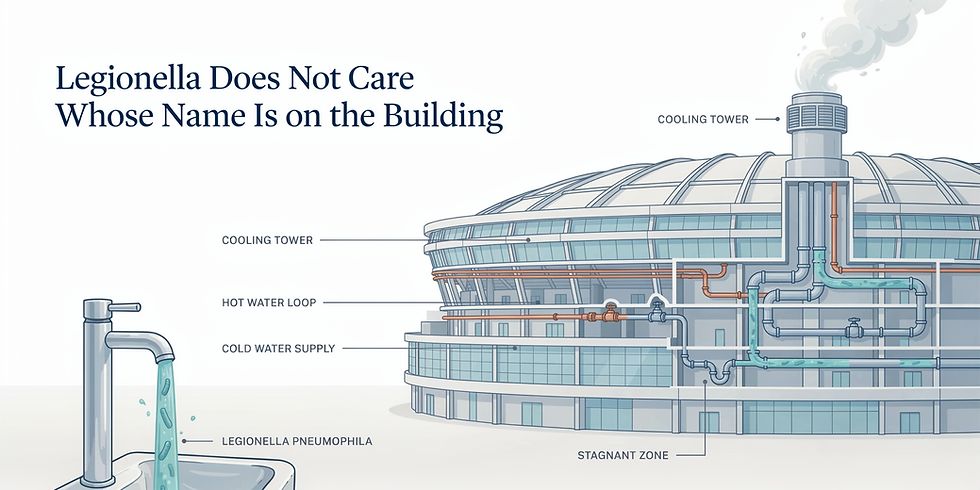
Legionella Does Not Care Whose Name Is on the Building
Hospitals, hotels, nursing facilities, stadiums, apartment buildings, office complexes and other large facilities all operate water systems that can potentially create conditions favorable to Legionella.
Legionella occurs naturally in freshwater environments. The greater concern begins when it enters human-made water systems where conditions allow it to grow and spread. CDC identifies large plumbing systems, cooling towers, showerheads, faucets, hot tubs, decorative fountains and other water-containing equipment among the potential sources of exposure.
The bacteria are generally transmitted when a person inhales very small droplets of contaminated water. Legionnaires' disease is generally not spread from person to person.
That makes Legionella fundamentally different from many infectious diseases that receive greater public attention.
When influenza, COVID-19 or another respiratory virus spreads through a community, people tend to understand the concept immediately.
Legionnaires' disease is different.
Someone can walk into a building perfectly healthy and potentially encounter the organism through the building's water infrastructure.
The building itself can become part of the investigation.
That is one reason Legionella events so often become news.
The Disease May Be Less Familiar. The Consequences Are Not Minor.
Legionnaires' disease is a serious form of pneumonia caused by Legionella bacteria. Hospitalization is common, according to CDC, the overall case-fatality rate is approximately 10 percent.
In healthcare-associated cases, where patients may already be medically vulnerable, CDC reports an average case-fatality rate of approximately 25 percent.
Those numbers deserve attention.
People at increased risk include adults 50 and older, current or former smokers, people with chronic lung disease, people with weakened immune systems and those with certain underlying medical conditions including cancer, diabetes, kidney failure and liver failure.
For hospitals, long-term care facilities and other organizations serving vulnerable populations, that changes the conversation considerably.
This is not simply a water-quality issue.
It is a patient-safety issue.
Why Does Legionella Keep Appearing in the News?
Part of the answer is that reported Legionnaires' disease has been increasing for years.
CDC surveillance data show that reported cases have generally increased since the early 2000s. After declining during the first year of the COVID-19 pandemic, reported cases rebounded in 2021. CDC continues to monitor Legionnaires' disease nationally because legionellosis is a nationally notifiable condition.
Another reason is simply the nature of the disease.
When several cases occur within a geographic area or are potentially associated with a facility, public-health investigators begin looking for a common environmental source.
Cooling towers may be tested.
Building water systems may be investigated.
Facilities may be publicly identified.
Remediation orders may be issued.
And suddenly a microorganism most people rarely think about is associated with the name of a hospital, hotel, senior living facility, apartment complex or, in this case, one of the most recognizable sports venues in the country.
That association can happen before investigators have established the actual source of the illnesses.
That is an important lesson for facility leadership.
The Reputation Problem Begins Before the Investigation Ends
There is another side of Legionella management that does not receive enough attention: public perception.
Organizations spend years developing confidence with patients, residents, guests and the communities they serve.
A headline containing the organization's name alongside the words Legionella or Legionnaires' disease can immediately create questions:
Is the water safe?
Were people exposed?
Did someone get sick?
Was the building being properly maintained?
Could this have been prevented?
Those questions can arise even when an investigation ultimately determines that the facility was not responsible for an illness.
The Yankee Stadium situation demonstrates that point particularly well.
The official public-health information contains significant nuance. A tower produced a preliminary PCR-positive result. PCR does not determine whether the detected organisms were alive. The tower has not been established as the source of exposure. No current Legionnaires' disease cases have been linked to Yankee Stadium.
Yet "Legionella detected at Yankee Stadium" understandably became the headline.
For organizations responsible for public buildings, healthcare facilities and vulnerable populations, that should be another reason to take water management seriously.
You cannot control every headline.
You can control how well prepared you are before one exists.
Having a Plan Is Not the Same as Managing the Water
This is where effective water management becomes critical.
CDC recommends water management programs for buildings and devices at increased risk for Legionella growth and transmission. These programs are not intended to be documents that sit on a shelf.
CDC's framework calls for facilities to identify areas where Legionella could grow and spread, establish control measures and control limits, monitor those controls, establish corrective actions when limits are missed, verify that the program is functioning and document the work being performed.
That distinction is important.
A facility can have a Water Management Plan.
The real question is whether the water itself is being managed.
Are temperatures being monitored?
Are disinfectant residuals reaching distal locations?
Are areas of stagnation being identified?
Are changes in the building being incorporated into the plan?
Are corrective actions actually occurring when control limits are missed?
Is someone verifying that those corrective actions worked?
CDC specifically identifies temperature, disinfectant residual, pH and areas of low water movement as important parameters when evaluating building water.
And perhaps one of the most important CDC findings in this entire discussion is this:
Investigations of Legionnaires' disease outbreaks found that approximately 9 out of 10 outbreaks were associated with problems that could have been prevented through more effective water management.
That should be the headline facilities remember.
A Positive Result Should Trigger Action, Not Panic
Finding Legionella does not automatically mean someone will become ill.
It does not automatically mean a facility caused an illness.
And depending on the testing method, a positive result may not even establish that viable Legionella bacteria are present.
But it does mean the result should be understood, investigated and addressed within the context of the facility's water management program.
The goal should never be panic.
The goal should be preparedness.
Know the system.
Know the vulnerable population you serve.
Know your control measures.
Monitor them.
Verify that they are working.
And have a predetermined response for when they are not.
Because Legionella is unlikely to disappear from the news.
The more important question is whether your organization will be prepared if it ever becomes part of the story.


Comments