
BACK FROM THE DEAD: WHEN LEGIONELLA RETURNS
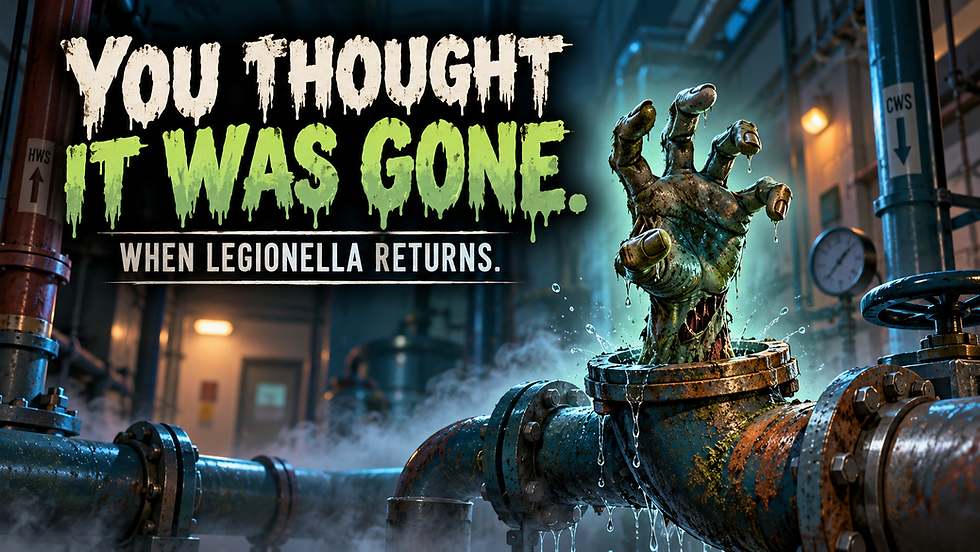
You thought the problem was buried. Then came the next positive test.
A Halloween Special from Legionella Specialties
The horror movie that every facility manager hopes never gets a sequel.
Picture this.
It's a quiet Monday morning at the hospital. The coffee is hot, the maintenance team is catching up on work orders, and everything seems perfectly normal.
Then the phone rings.
"We just received the latest water sampling results."
The facility manager pauses.
"Please tell me they're negative."
There's an uncomfortable silence.
"Well..."
Cue the terrifying music.
It's back.
The same unwanted visitor you thought you had eliminated months ago has apparently decided to make another appearance.
And unlike your average Halloween villain, this one doesn't need a full moon, a haunted cemetery, or an ancient curse.
All it needs are the right conditions inside your plumbing system.
Welcome to Back From the Dead: When Legionella Returns.
The First Time It Showed Up
The first positive Legionella test can turn an otherwise ordinary day into a very expensive problem.
Emergency meetings. Phone calls. Questions from infection prevention. Additional sampling. Potentially urgent remediation.
And the question everybody wants answered:
"How quickly can we get rid of it?"
The facility responds. Corrective actions are implemented, the system is treated, and follow-up testing eventually produces the results everyone was hoping for.
Negative.
The conference room exhales.
The facility manager gets a decent night's sleep.
The monster has been defeated.
Roll credits.
Except there's one little problem.
Nobody checked to see whether the villain had a sequel planned.
The Sequel Nobody Asked For
Here's the unsettling part.
According to the CDC's Legionella Control Toolkit, successful remediation does not necessarily correct the underlying problems that allowed Legionella to grow in the first place.
If those conditions remain, the bacteria are likely to recolonize the water system.
That's worth reading twice.
A successful remediation can be exactly that: successful. But without addressing the conditions behind the contamination, the success may be temporary.
So why does Legionella return?
Let's meet the supporting cast.
The Four Accomplices
1. Biofilm: The Perfect Hiding Place
Inside building plumbing, microorganisms can form communities within protective layers known as biofilm.
Biofilm can protect Legionella and other microorganisms from environmental stresses, including exposure to disinfectants. It also creates favorable environments for persistence and growth.
In other words, you might clean up the crime scene without eliminating the conditions that made it attractive in the first place.
2. Stagnation: The Abandoned Wing
Every good horror movie has an abandoned room nobody wants to enter.
In a building, it might be an unused patient room, an infrequently operated shower, a dead leg, or a section of plumbing with little water movement.
When water stagnates, disinfectant residuals can decline, temperatures can drift, and biofilm can accumulate.
And suddenly, that quiet little corner of the plumbing system becomes much more interesting to Legionella.
3. Temperature: The Uncomfortable Comfort Zone
Legionella grows particularly well in certain warm-water conditions.
The CDC identifies approximately 77°F to 113°F (25°C to 45°C) as a favorable growth range, although growth can occur at lower temperatures under some circumstances.
Poorly controlled hot water temperatures, inadequate recirculation, and warming of cold-water lines can all contribute to the problem.
Your building may have a temperature problem long before anyone notices a microbiological one.
4. Disinfectant Residual: The Missing Security Guard
Disinfectants help limit microbial growth throughout a water distribution system.
But disinfectant residuals can decline as water moves through plumbing, especially where water age increases or the system contains conditions that accelerate disinfectant demand.
The city may have delivered appropriately treated water.
That doesn't guarantee adequate disinfectant residual will remain at every faucet and shower.
And Legionella doesn't care whose responsibility that was.
One Negative Test Is Not a Lifetime Warranty
Let's clear up an important misconception.
A negative Legionella result is encouraging. It means the organism was not detected in that particular sample using the testing method employed.
But it isn't proof that every inch of plumbing is free from Legionella, nor is it a promise that future samples will remain negative.
The CDC emphasizes that sampling must represent the water system and that Legionella test results must be evaluated alongside other indicators of system control. Testing alone neither measures health risk nor predicts whether someone will develop disease.
Think of it like checking your house for a burglar.
You look in the living room.
Nobody's there.
Great news.
But you probably shouldn't assume you've inspected every room, closet, attic, and basement.
Water systems work much the same way.
A negative result tells you something important about the sample. Ongoing monitoring helps you understand what's happening throughout the system.
How Do You Keep the Sequel From Happening?
Here's where the story changes.
Instead of responding every time Legionella makes another appearance, what if we focused on maintaining conditions that make its growth less likely in the first place?
That's the foundation of effective water management.
The CDC identifies four critical factors affecting Legionella growth in potable water systems:
Sediment and biofilm
Temperature
Water age
Disinfectant residual
The CDC's Legionella Control Toolkit brings these together under a simple acronym: STAR.
The objective isn't simply to respond to the latest positive sample. It's to understand the system, control the conditions supporting microbial growth, and verify that those controls are working.
That means monitoring water chemistry, evaluating problematic plumbing conditions, maintaining proper temperatures, addressing stagnation, and establishing corrective actions when control limits aren't met.
And where appropriate, it can also mean supplemental continuous disinfection.
A Different Ending: Continuous Treatment
At Legionella Specialties, we believe facilities should spend less time reacting to water problems and more time preventing the conditions that allow them to develop.
That's why our approach incorporates ongoing monitoring, system evaluation, and, where appropriate, continuous treatment using our WaterGuard MO Mineral Oxychloride technology.
Rather than relying exclusively on periodic remediation, continuous disinfection is intended to help maintain an appropriate disinfectant residual throughout the treated water system.
But it's important to understand that no disinfectant, by itself, solves every water management problem.
Stagnant branches, temperature deficiencies, neglected fixtures, and equipment issues still require attention.
In fact, the CDC explicitly states that no single control measure ensures Legionella control in potable water systems.
Effective treatment should work alongside a properly implemented water management program, not replace it.
The goal is to create an environment where the conditions supporting Legionella growth are consistently controlled.
And that leads us to the most important question.
Are You Treating the Problem, or Just the Positive Test?
Think about how facilities often approach waterborne pathogens.
A positive test triggers a response.
The system is treated.
Follow-up testing improves.
Everyone moves on.
But what happens next month?
Or six months from now?
Have the temperatures changed?
Are previously unused fixtures still stagnant?
Are disinfectant residuals reaching distal outlets?
Has incoming water quality changed?
Is the water management program being verified and validated?
These questions matter because water systems aren't static.
They change with occupancy, seasonal conditions, water demand, equipment operation, and the quality of the incoming supply.
That's why continuous attention to water quality is so important.
The real objective isn't simply to get a negative test today. It's to maintain a system in which Legionella growth remains well controlled tomorrow, next month, and next year.
The Final Scene
Let's return to our facility manager.
This time, when the phone rings, he's not completely in the dark.
He has established monitoring data.
He knows where his disinfectant residuals stand.
He understands the system's temperature trends and potential stagnation points.
His team has a water management program that is actively implemented, reviewed, and adjusted as necessary.
And if testing identifies a problem, they have information to investigate it instead of starting from scratch.
Does that mean Legionella can never return?
Of course not.
But it means the facility is better prepared to recognize, investigate, and address the conditions that allow it to grow.
And in the world of water management, that's a much better ending.
This Halloween, don't just worry about what's lurking in your water system. Make sure you're controlling the conditions that invited it in.
Because the best way to avoid a horror-movie sequel...
Is to stop setting the stage for one.
Happy Halloween from Legionella Specialties.
Chasing Zero.


Comments