.png)
We’re Not Immune: Why Infection Prevention Still Matters in 2026

Recent reports of a hantavirus outbreak on a cruise ship are a tragic and sobering reminder of something we don’t talk about enough:
Even in 2026, we are not immune to biological risk.
First and foremost, situations like this deserve to be approached with respect. These types of outbreaks are often complex, and in many cases, not the result of negligence or error. Some pathogens originate from environmental or external sources that are difficult to predict or fully control.
But moments like this still serve an important purpose.
They remind us that infectious threats are not a thing of the past. They are still present. Still active. Still capable of causing serious harm under the right conditions.
And more importantly, they highlight a critical distinction that every healthcare facility and building operator needs to understand:
Some risks are unavoidable. Others are entirely within our control.
Unavoidable vs. Preventable Risk
Hantavirus, like many zoonotic diseases, is typically introduced through environmental exposure. These are scenarios that can be difficult to anticipate and even harder to fully eliminate.
But not all pathogens operate that way.
Legionella is different.
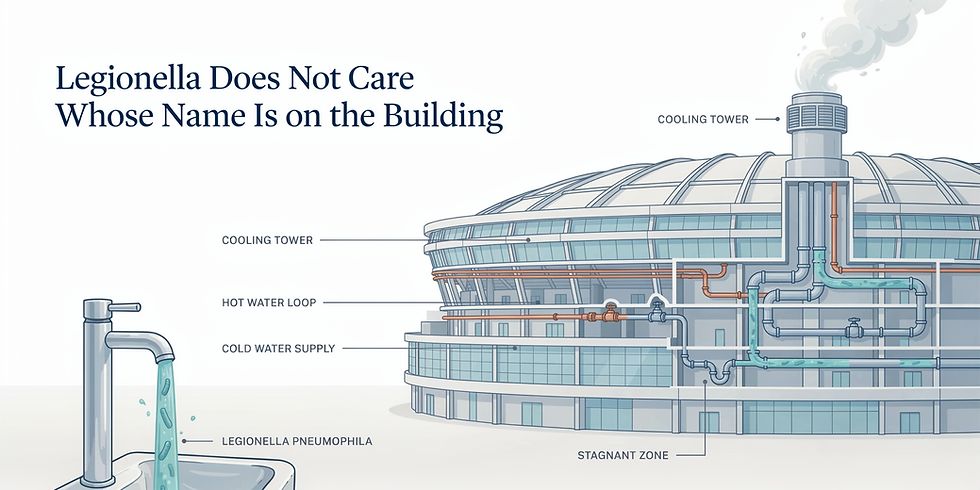
Legionella doesn’t just appear randomly. It follows patterns. It thrives under known conditions:
Stagnant water
Warm temperatures
Low or inconsistent disinfectant levels
Biofilm inside plumbing systems
These aren’t unknown variables. These are controllable system conditions.
Which means Legionella isn’t just a risk.
It’s a manageable one.
The Reality Inside Building Water Systems
Every large building, especially healthcare facilities, has a complex water system. Hot water loops, storage tanks, distal outlets, mixing valves… all of it creates an environment where water is constantly moving, cooling, heating, and interacting with surfaces.
And with that complexity comes opportunity.
Opportunity for bacteria to enter through incoming water.
Opportunity for it to grow inside biofilm.
Opportunity for it to spread throughout the system.
This is why a few negative test results don’t tell the full story. And it’s why a one-time remediation effort isn’t a long-term solution.
Water systems are dynamic. Risk doesn’t stay fixed. It evolves daily based on conditions.
Control Is Not a One-Time Event
Flushing, heat treatments, and short-term remediation all have their place. They can reduce immediate risk.
But they don’t prevent recurrence.
Because the two fundamental pathways still exist:
Introduction through incoming water
Amplification within the system
If those pathways aren’t continuously controlled, the problem returns.
That’s why effective Legionella prevention requires:
Maintaining a consistent disinfectant residual
Monitoring ORP and system performance
Reducing microbial loading (ATP)
Ensuring conditions don’t allow regrowth
This isn’t about reacting to a problem.
It’s about maintaining control over time.
Control What You Can
Not every outbreak is preventable.
But some are.
And those are the ones we’re responsible for.
Infection prevention in 2026 isn’t about fear or overreaction. It’s about understanding where risk exists, knowing what drives it, and taking consistent action to control it.
Because while we may not be able to stop every biological threat…
We can, and should, control the ones inside our own systems.
Closing Thought
Outbreaks like the recent hantavirus case remind us how serious infectious disease can be.
But they should also sharpen our focus.
The real question isn’t whether risk exists.
It’s whether we’re actively managing the risks we already understand.


Comments