.png)
The Hidden Risk Inside Facility Water Systems: Why Pipes, Dead Legs, Biofilm, Flushing, and Disinfectant Matter

When people think about Legionella risk in large facilities, they often think first about cooling towers or incoming city water. Those are important, but they are only part of the story.
In many buildings, the bigger issue is not simply what enters the facility. It is what happens after the water gets inside.
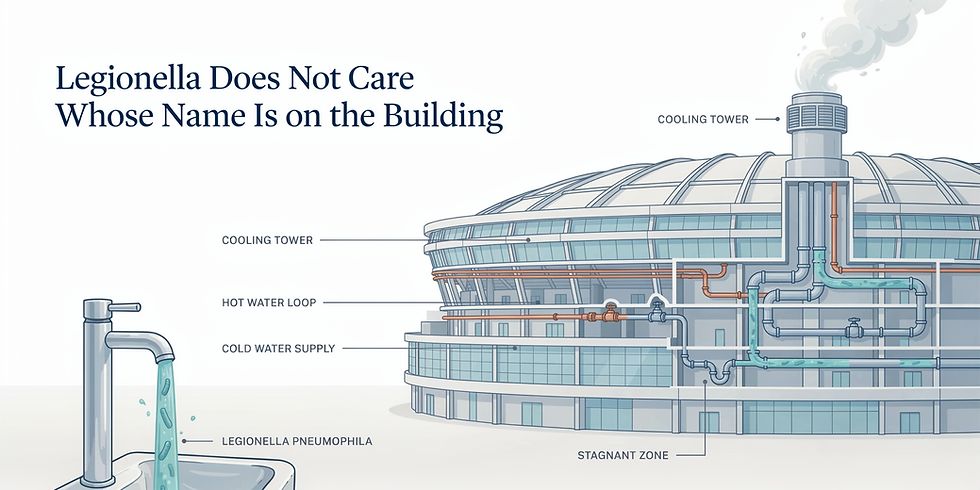
A facility water system is not a straight pipe from the city main to the faucet. It is a complex network of hot water loops, cold water lines, storage tanks, recirculation systems, thermostatic mixing valves, showers, faucets, hose connections, equipment feeds, low-use outlets, capped lines, renovations, unused branches, and hidden piping runs. Every one of those areas can affect water quality.
That matters because Legionella and other waterborne pathogens do not need the entire system to be “bad” to create risk. Sometimes the problem is hiding in a small section of pipe, a low-flow branch, a shower hose, a distal outlet, or a dead leg that has not moved water properly in weeks or months.
CDC guidance specifically tells healthcare facilities to identify areas of stagnation, including dead legs and vacant units or rooms, areas with no residual disinfectant, and areas where temperatures can support microbial growth.
The Problem Is Often in the Plumbing
A major misconception in water safety is that if the incoming water is acceptable, the building water must also be acceptable. Unfortunately, that is not how premise plumbing works.
Once water enters a large facility, it can lose disinfectant residual, warm into the Legionella growth range, sit in storage, slow down in low-use areas, pick up nutrients from sediment or corrosion, and interact with biofilm on the inside walls of pipes.
CDC’s potable water guidance recommends ensuring a detectable disinfectant residual throughout the potable water system and flushing low-flow piping runs and dead legs at least weekly. It also specifically identifies components such as thermostatic mixing valves, aerators, showerheads, hoses, filters, and storage tanks as items that need regular cleaning and maintenance.
That is the key point: water safety is not just about the source. It is about the condition of the entire building water system.
What Is a Dead Leg?
A dead leg is a section of pipe where water has little or no regular flow. It may be a capped-off line from an old remodel, a branch serving a rarely used fixture, a section of pipe connected to an abandoned room, or a run that was never fully removed when plumbing was changed.
The danger is stagnation.
When water sits, several things can happen:
The disinfectant residual can drop or disappear.
Hot water can cool into the ideal Legionella growth range.
Cold water can warm up inside the building.
Sediment and organic material can accumulate.
Biofilm can thicken.
Bacteria and amoebae can create a protected environment inside the pipe.
CDC notes that the most favorable Legionella growth range is 77°F to 113°F, or 25°C to 45°C, and that Legionella may grow at temperatures as low as 68°F, or 20°C.
That means a stagnant section of pipe does not have to be hot like a spa to become a risk. It only has to sit long enough, lose disinfectant, and land in the wrong temperature range.
The Evidence on Stagnation Is Strong
This is not just theory. A systematic literature review published in Frontiers in Environmental Science examined the role of water stagnation and flow dynamics in potable water systems.
The review found that 22 of 24 identified studies showed a positive association between stagnation zones and increased Legionella colonization. These stagnation zones included dead legs, dead ends, storage tanks, and areas with obstructed or intermittent water flow.
That same review explained that prolonged stagnation can reduce the quality of chemically or thermally treated water, stimulate Legionella biofilm colonization, accelerate disinfectant decay, and create conditions where Legionella may persist in biofilms or within protozoan hosts.
In plain English: stagnant water gives bacteria time, shelter, food, and protection.
Biofilm Is the Real Hiding Place
One of the most important things facility teams need to understand is that Legionella is not always floating freely in the waterwaiting to be captured by a single sample. It is often associated with biofilm.
Biofilm is a layer of microorganisms that attaches to wet surfaces inside pipes, fixtures, tanks, valves, and other plumbing components. Once established, biofilm can protect bacteria from disinfectants, release organisms intermittently, and make water quality inconsistent from one fixture to the next.
CDC’s 2024 drinking water outbreak surveillance report explains that biofilms are microbial communities that attach to moist surfaces such as water pipes and provide protection and nutrients for pathogens, including Legionella and nontuberculous mycobacteria.
That is why one sink can test fine while another outlet in the same facility has elevated microbial activity. The system is not always uniform. The risk can be local, hidden, and intermittent.
Distal Points Can Be Higher Risk Than Central Locations
Another mistake is assuming that testing only incoming water, a mechanical room, or a main hot water loop gives a full picture of building risk.
The National Academies’ report on Legionella management states that there is strong evidence that Legionella concentrations in distal sites of premise plumbing can be significantly higher than in more centralized sections. It also notes that faucets and showerheads provide surfaces for biofilm growth and are subject to recurring stagnation.
This is exactly why sampling strategy matters. A good water management program should not only look at the water heater or incoming supply. It should include representative distal outlets, high-risk patient care areas, low-use fixtures, hot and cold water locations, storage, return loops, and areas where flow patterns may be poor.
Why Disinfectant Residual Matters
Municipal water arrives with some level of disinfectant, but that does not mean the residual will survive throughout a large building.
Large facilities can have long pipe runs, storage tanks, warm water, high water age, organic material, corrosion, sediment, and biofilm. All of these can consume disinfectant before it reaches distal fixtures.
The National Academies states that maintaining a disinfectant residual can be an integral part of a building’s water management plan for Legionella control and that disinfection should be paired with scheduled water testing to confirm that the system maintains residual.
EPA’s scientific literature review also emphasizes that there is no one-size-fits-all approach to Legionella control in premise plumbing because buildings vary in pipe material, age, condition, water usage, water age, and water quality.
That is why a facility cannot simply assume that city water treatment is enough. The building itself changes the water.
Why Flushing Is Not Optional
Flushing is one of the most basic and important control measures in a water management program. It helps move old water out, bring fresh disinfectant residual into low-use areas, reduce water age, and prevent temperature drift.
CDC recommends flushing low-flow pipe runs and dead legs at least weekly and flushing infrequently used fixtures regularly as needed to keep water quality within control limits.
But flushing has to be intentional. Randomly running a few faucets is not the same as a documented flushing protocol.
A strong flushing program should identify:
Low-use fixtures
Vacant rooms
Dead legs or suspected dead legs
Long pipe runs
High-risk patient care areas
Showers and hand-held spray devices
Areas with low disinfectant residual
Areas where ORP, ATP, chlorine, or temperature are outside control limits
Flushing should also be verified with water quality data whenever possible. The goal is not just to “run water.” The goal is to restore water quality.
The Public Health Data Supports a Source-to-Tap Approach
CDC’s surveillance of drinking water-associated outbreaks from 2015 to 2020 found 214 reported outbreaks, resulting in at least 2,140 illnesses, 563 hospitalizations, and 88 deaths. Of those outbreaks, 187, or 87%, were associated with biofilm-related pathogens. CDC also reported that Legionella-associated outbreaks have increased over time and were the leading cause of reported drinking water outbreaks, including hospitalizations and deaths.
That is why water safety has to be managed from source to tap.
It is not enough to ask, “Is the city water good?”
The better questions are:
What happens to the water after it enters the building?
Where does water sit?
Where does disinfectant disappear?
Where does temperature support microbial growth?
Where are dead legs, low-flow branches, and unused fixtures?
Where is biofilm likely to be established?
Where are vulnerable patients, residents, or visitors exposed to aerosols?
Where do showers, faucets, aerators, and hoses create risk?
The Bottom Line
Facility water systems are living, changing environments. They are affected by building age, renovations, fixture use, patient occupancy, water temperature, pipe design, storage, disinfectant residual, flushing, and maintenance.
Cooling towers and incoming water matter, but they are not the whole system.
The hidden risk is often inside the building itself, in the pipe runs, distal outlets, low-flow branches, dead legs, biofilm, and forgotten fixtures that quietly create the right conditions for bacteria to grow.
That is why effective Legionella prevention requires more than occasional testing. It requires a complete water management program, routine monitoring, documented flushing, systemwide disinfectant control, and a clear understanding of how water actually moves through the building.
Because in a large facility, bacteria do not need the whole system to fail.
They only need one protected place to hide.


Comments